Where DengTAI caged ladders go to work, worldwide.
Process plants, water utilities, transmission towers, roof access, warehouses, port cranes, grain silos and observation towers — eight industry verticals, five material systems, one passive fall-protection standard.
DengTAI caged ladders are installed in 8 industries: process plants, water utilities, energy, buildings, warehouses, ports, agriculture and observation towers. We offer 5 materials (carbon steel, hot-dip galvanized, aluminum, stainless steel, FRP) to match your environment and safety standards.
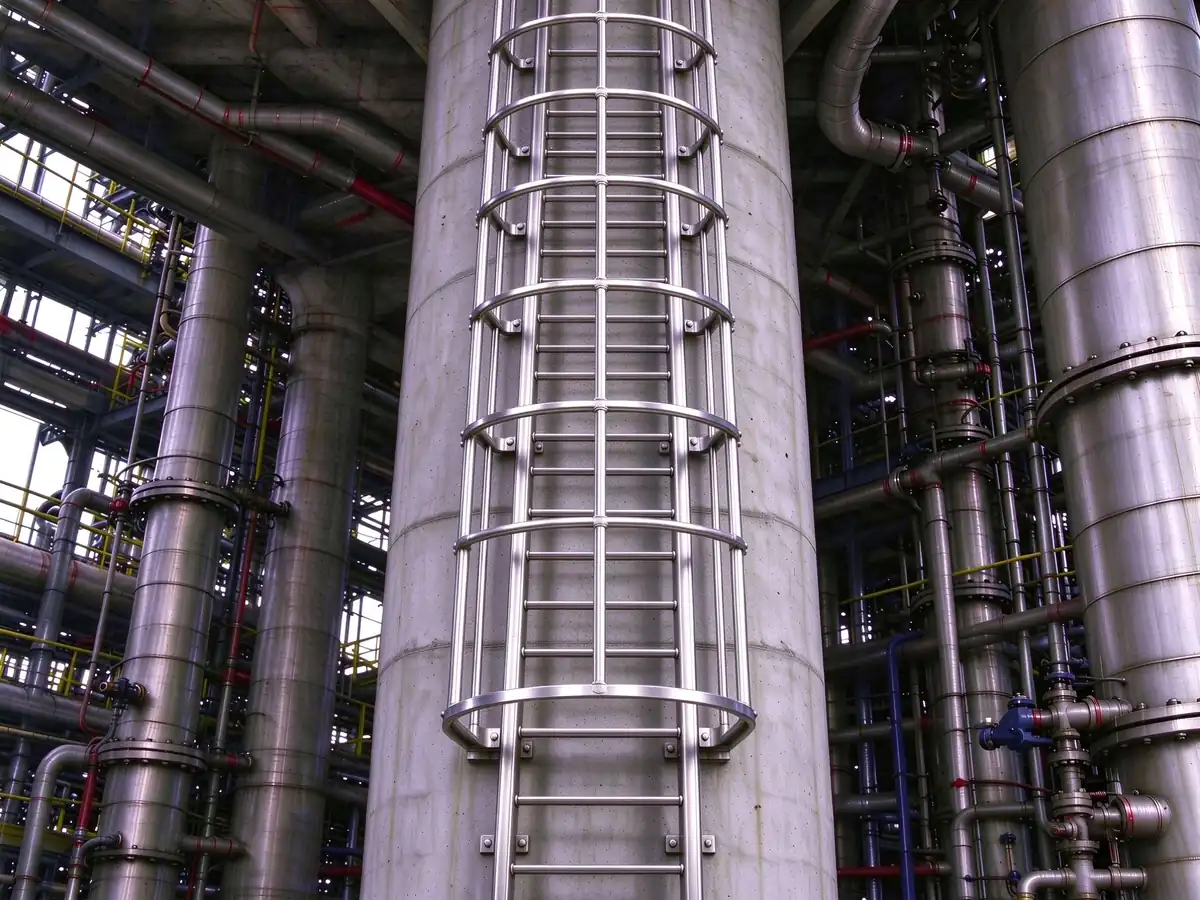
Industrial Manufacturing & Process Plants
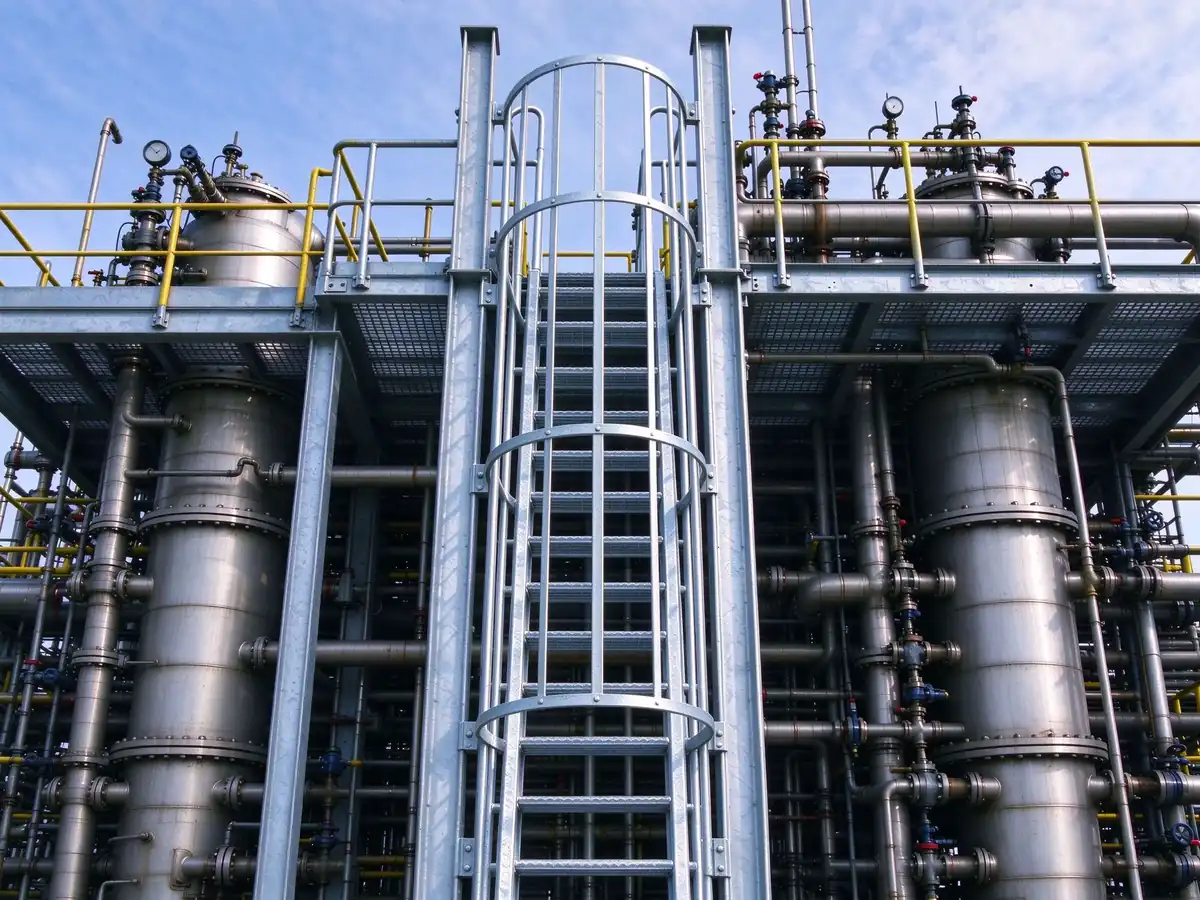
The most common installation for a caged ladder: vertical access to tanks, reactors, silos, conveyor galleries and boiler structures where workers must climb daily to inspect valves, level gauges, manways and dust collectors.
Recommended materials
Typical objects
- Vertical storage tanks (petrochemical, water, fuel)
- Reactors, distillation columns, absorption towers
- Cement / fly-ash / ore silos
- Belt conveyor galleries, bucket elevators
- Boiler casings, precipitators, ducts
Municipal & Public Utilities
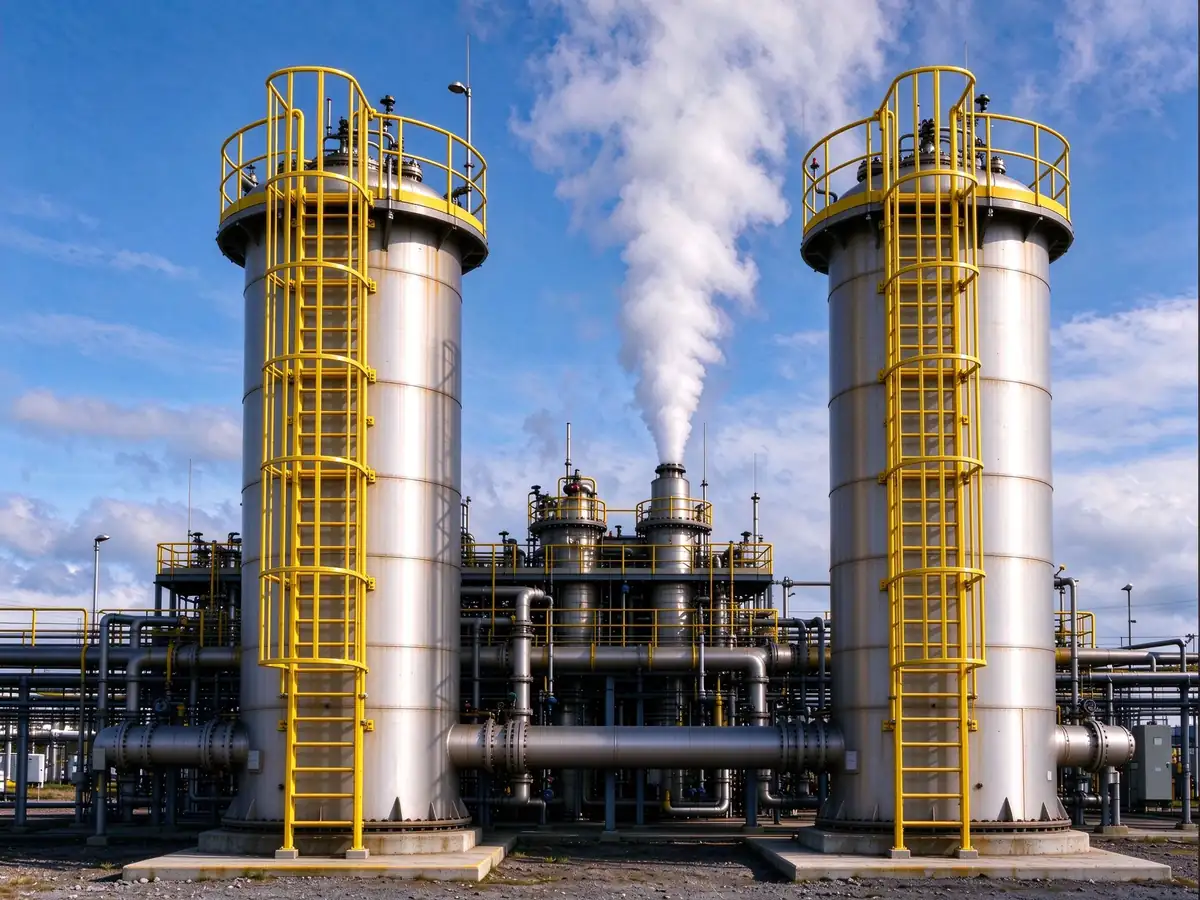
Water towers, treatment plants, bridges, tunnel ventilation shafts and chimneys — public infrastructure where a rusted ladder is not just a maintenance issue, it is a safety liability that regulators will shut a site over.
Recommended materials
Typical objects
- Elevated water towers and clear-water reservoirs
- Primary / secondary clarifiers, aeration basins
- Sludge digesters, UV disinfection channels
- Bridge piers, cable-stayed tower access
- Tunnel ventilation shafts and escape stair voids
- Chimneys and cooling towers
Energy & Power
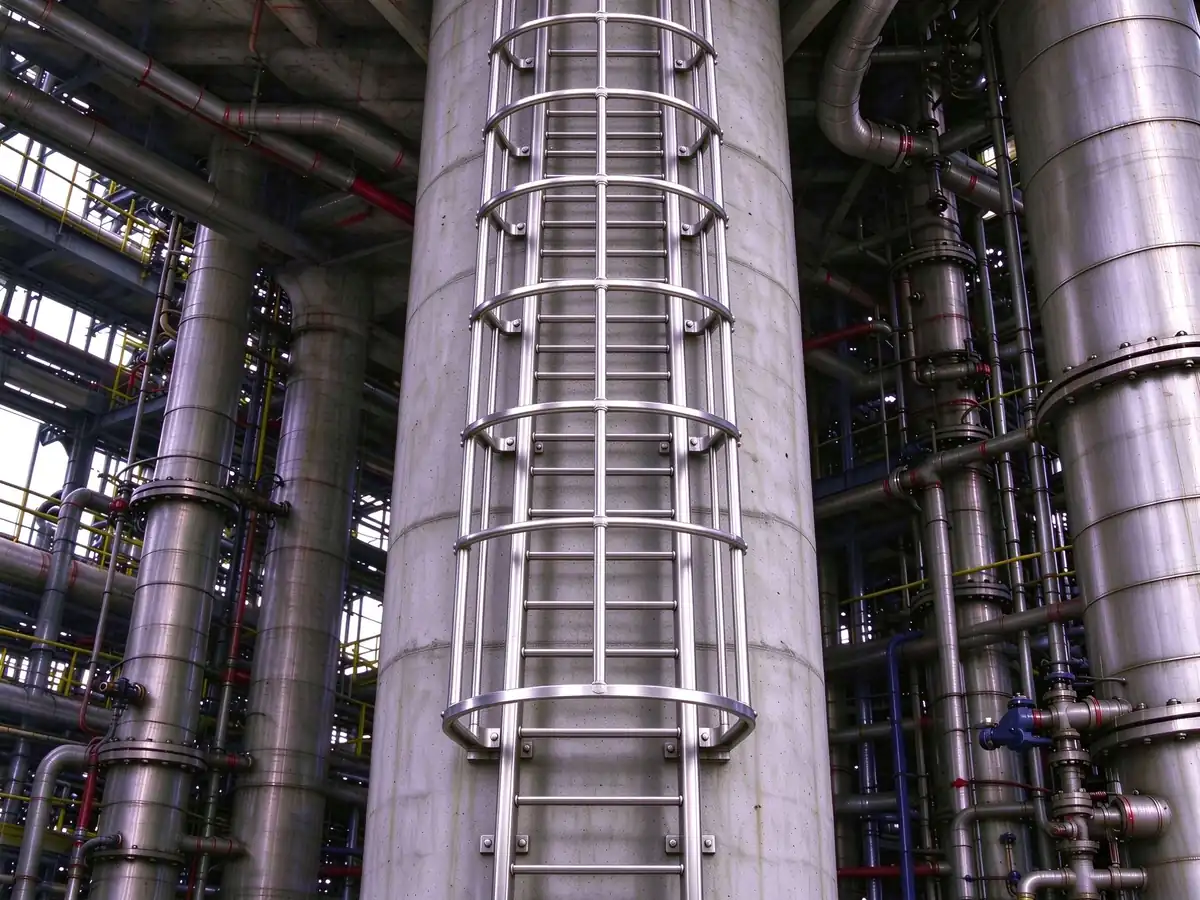
Transmission towers, substations, wind-turbine access, solar tracking systems and offshore platforms — vertical access where the working environment combines height, voltage and, increasingly, salt air.
Recommended materials
Typical objects
- Lattice transmission towers and substation gantries
- Wind-turbine tower internal ladders (early-generation units)
- Solar tracker drives, inverter platforms, BESS containers
- Offshore rigs, separators, metering skids
- Gas-station tank gauge ports
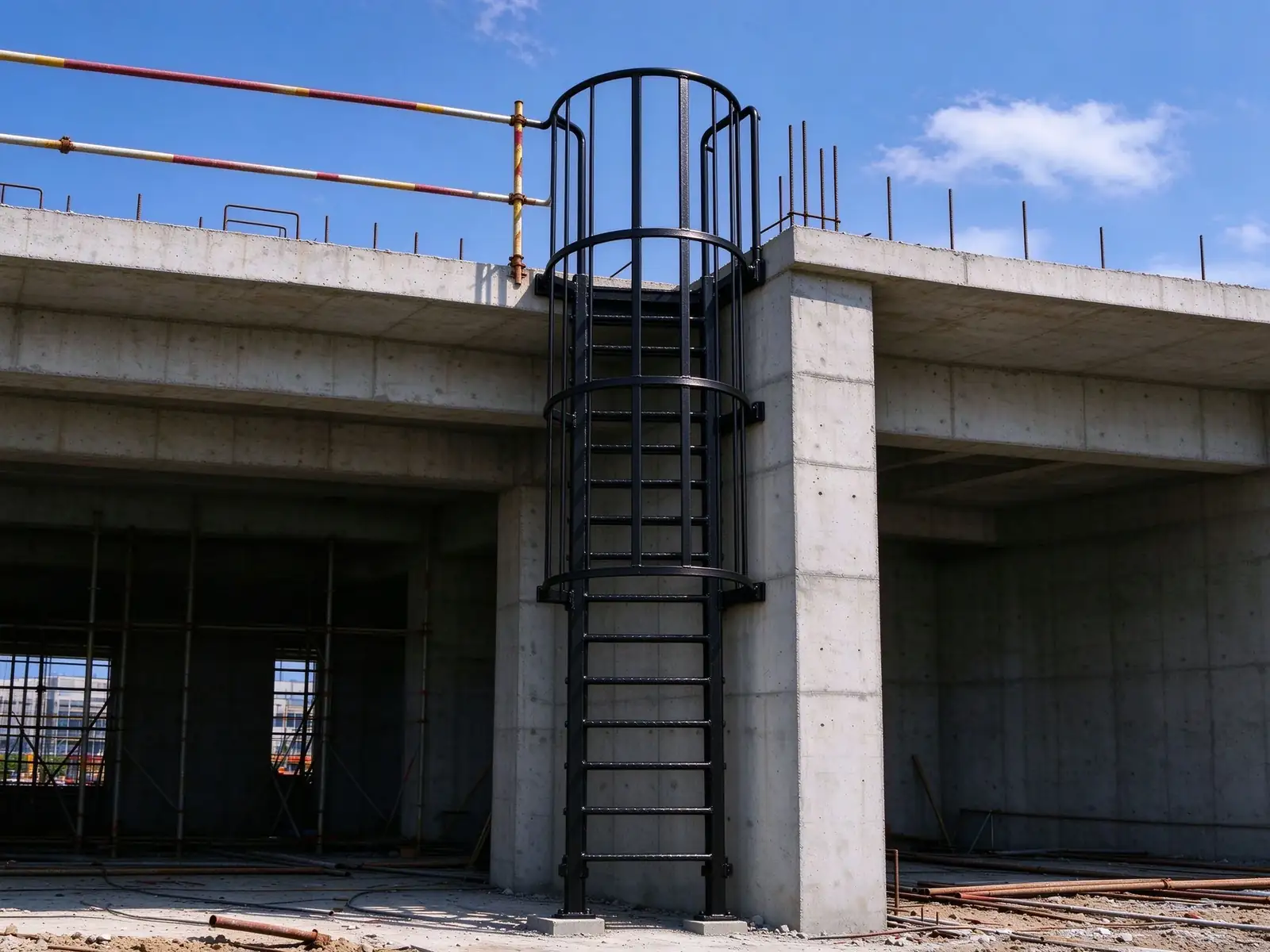
Building & Facility Maintenance
Roof access, AC platforms, billboards, hatch openings and façade maintenance — the vertical access most often retrofitted onto existing buildings, where load on the structure and appearance on the façade both matter.
Recommended materials
Typical objects
- Roof hatches, parapet walls, terrace exits
- AC condenser platforms, solar array frames
- Building maintenance unit (BMU) anchor tracks
- Billboards, high-pole signs, illuminated fascia
- Elevator machine rooms, tank rooms
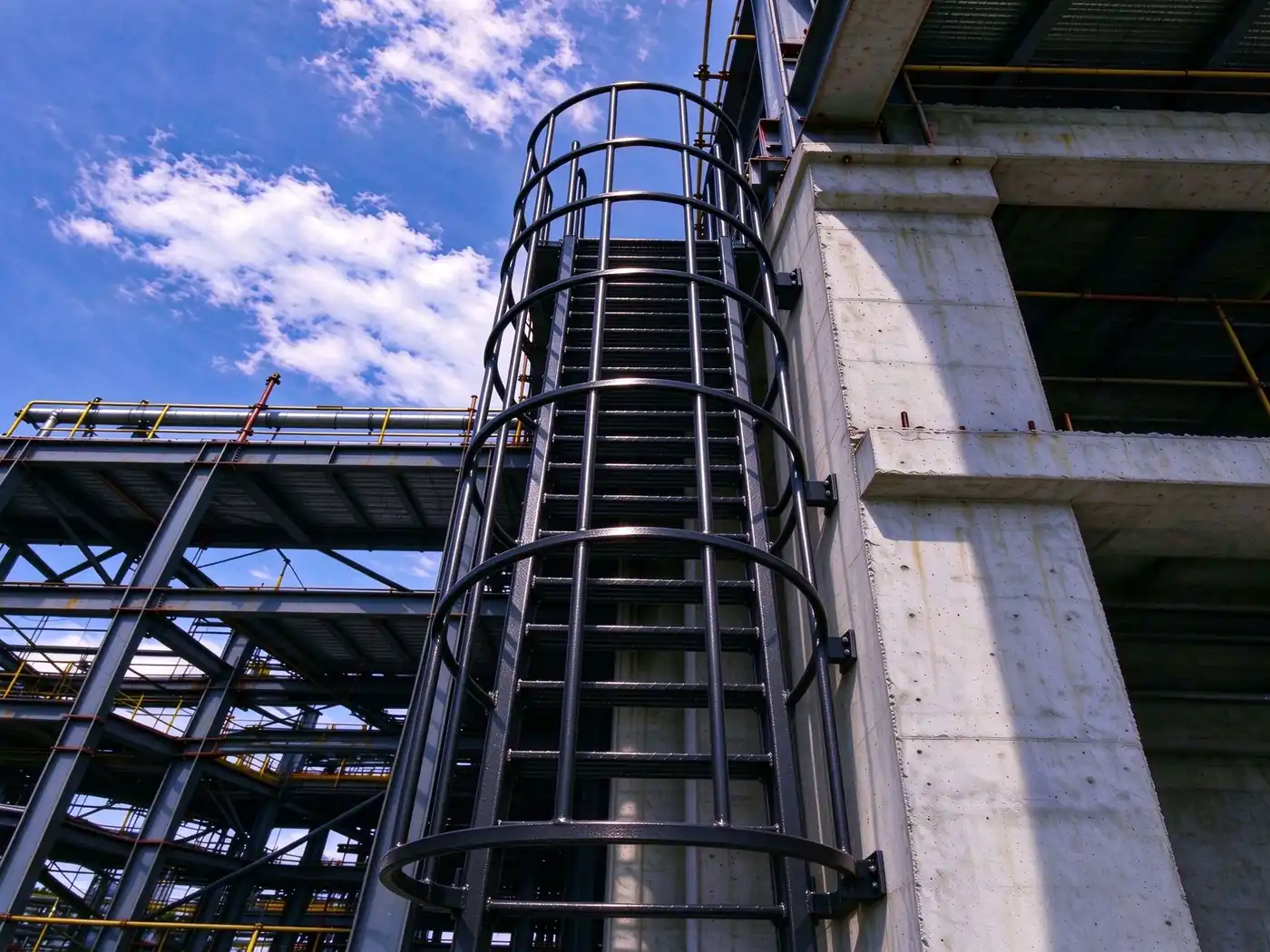
Warehousing & Logistics
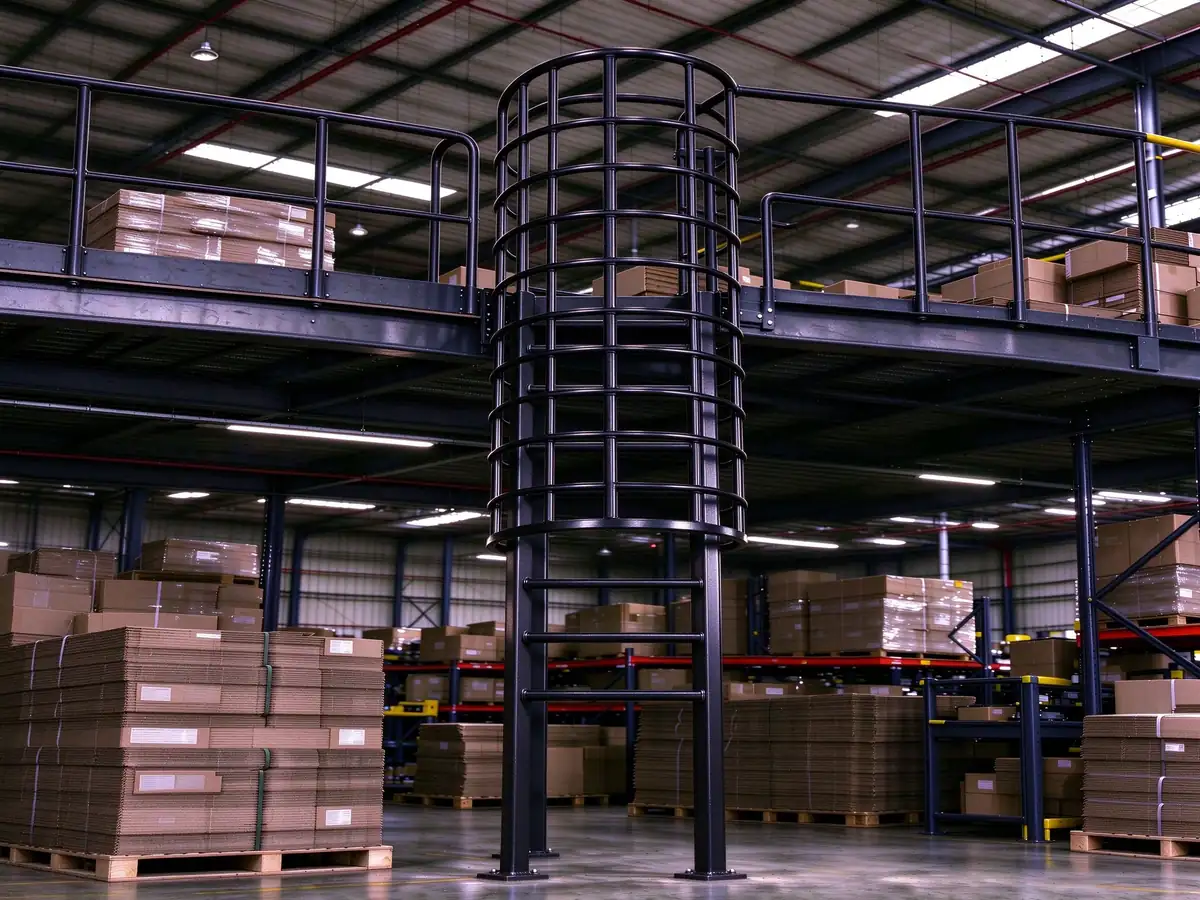
Mezzanine floors, high-bay rack maintenance tops and sortation-line equipment — indoor vertical access where cost is king but a forklift driving beneath the ladder makes a fall doubly dangerous.
Recommended materials
Typical objects
- Mezzanine (raised storage floor) access
- High-bay rack top inspection
- Sortation / cross-belt conveyor maintenance
- Dock levellers and charging-station platforms
Ports, Shipping & Transportation
Ship-to-shore cranes, container ships, railway catenary poles, ventilation shafts and airport control towers — vertical access exposed to salt air, heavy vibration and constant 24/7 operation.
Recommended materials
Typical objects
- Ship-to-shore (STS) cranes, RTG / RMG yard cranes
- Ship cargo tank access, engine room double bottom
- Railway catenary poles, signal masts
- Metro ventilation shafts, tunnel evacuation platforms
- Airport control towers, navaid stations
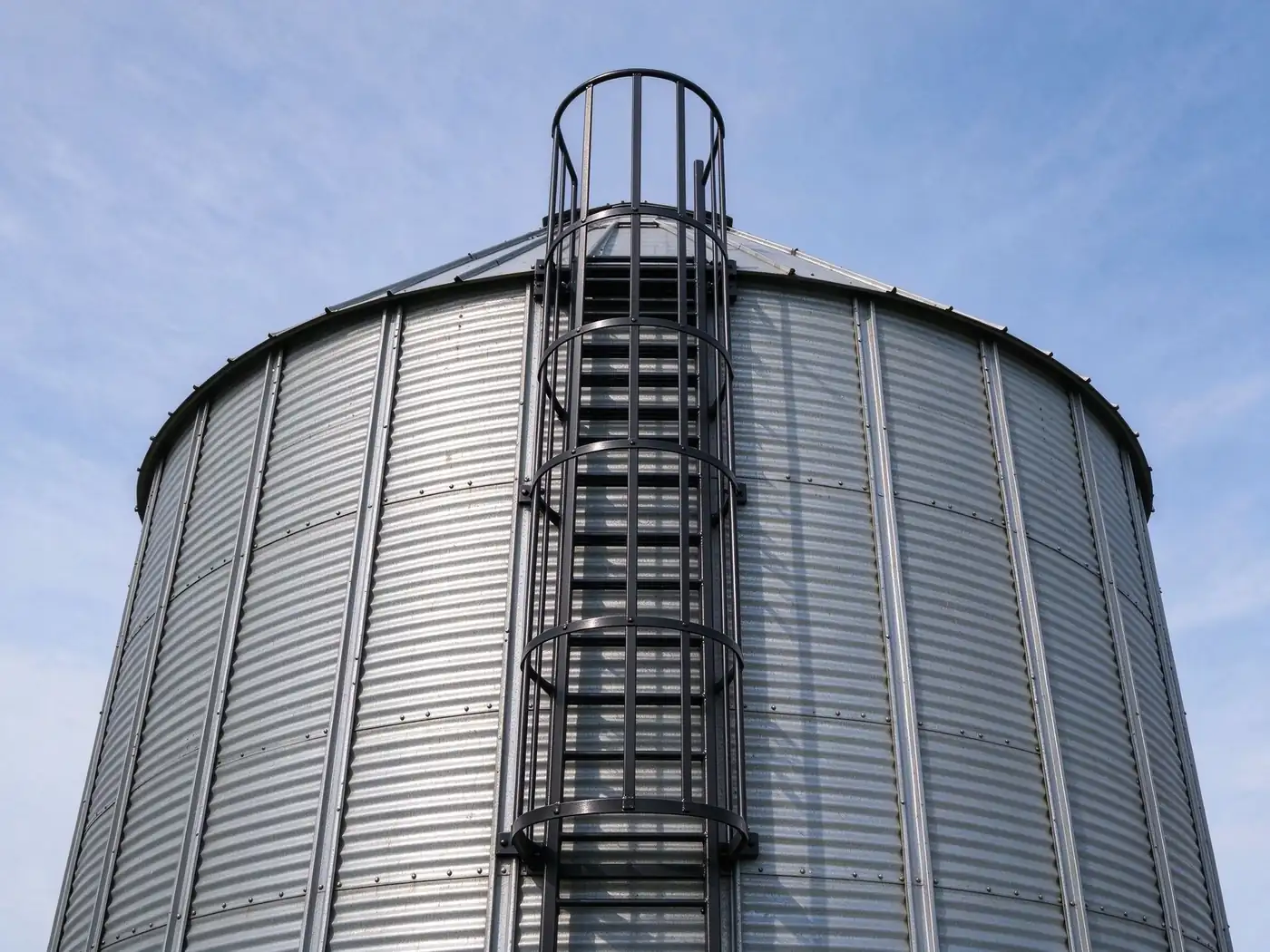
Agriculture, Food & Brewing
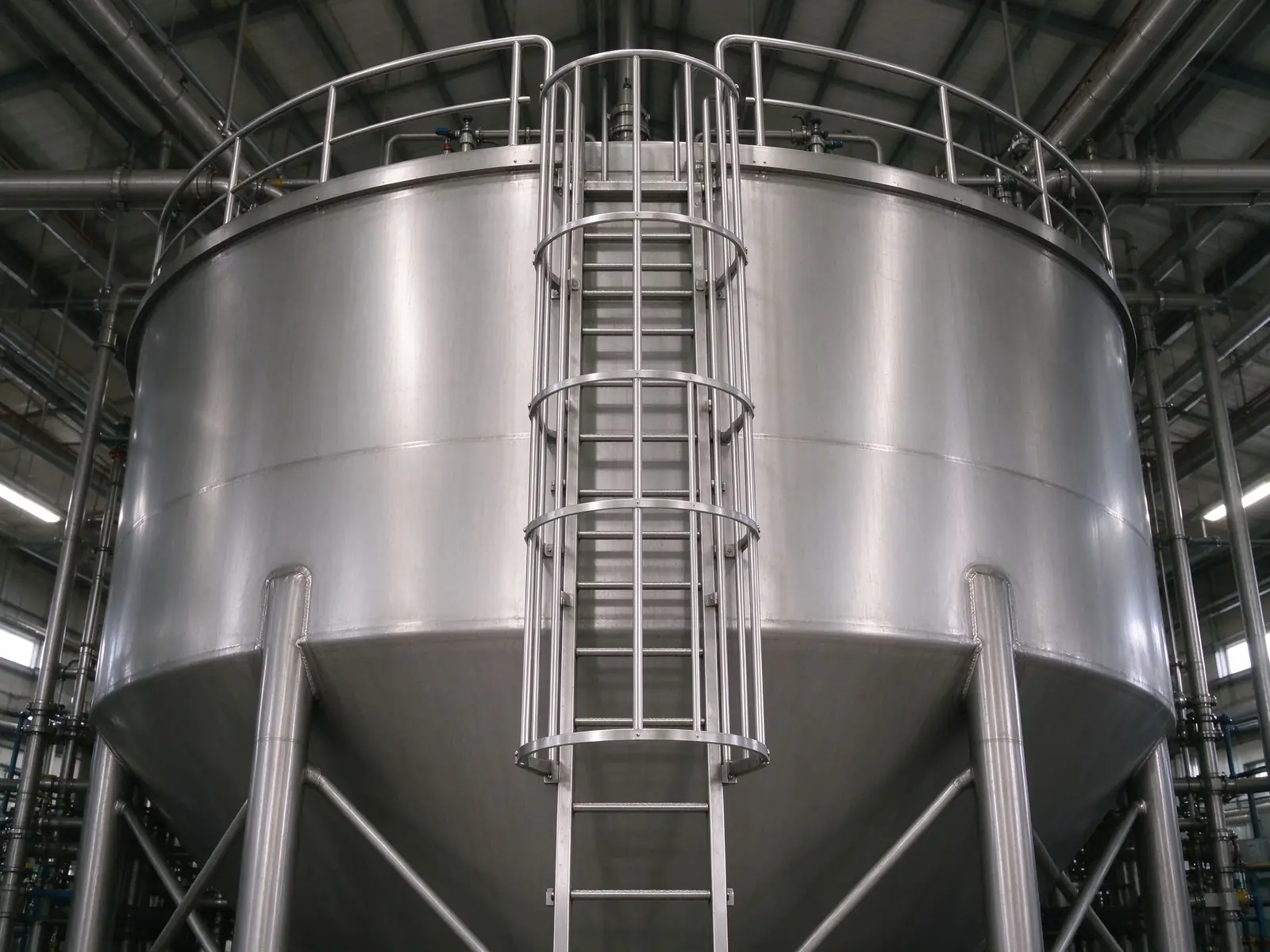
Grain silos, feed towers, brewing tanks, dairy vessels and fermenters — vertical access where either dust explosion risk or hygiene regulations dictate the material choice.
Recommended materials
Typical objects
- Vertical grain silos, shallow cylindrical bins, dryers
- Livestock feed towers, silage towers
- Brewing / wine / dairy fermentation tanks
- Soy-vinegar pits, sugar evaporators
- Irrigation pump stations, reservoir gates
Specialty & Extreme Access
Communication towers, observation outposts, radar arrays, theme-park rides and lighting masts — tall, remote, unmanned structures where the ladder is often the only way up for months at a time.
Recommended materials
Typical objects
- Monopole / lattice communication towers (30–80 m)
- Forest-fire lookout towers, border posts
- Radar antenna arrays, missile launch masts
- Theme-park ride maintenance access
- Stadium lighting masts, meteorological masts
Pick the right material for your site.
Five DengTAI material systems, matched to environment. Click through to the product page for full specifications.
| Environment | First choice | Alternative | Avoid | Product |
|---|---|---|---|---|
| Indoor, dry, general plant | Carbon steel, powder-coated | Aluminum | — | Carbon → |
| Outdoor tanks, silos, roofs, general structures | Hot-dip galvanized | SS304 | Painted carbon (short life) | HDG → |
| Existing roof retrofit, light load rating | Aluminum (anodized) | HDG | Stainless (too heavy) | Aluminum → |
| Food, pharma GMP, hygiene zones | SS304 / SS316 | FRP | Painted / galvanized | Stainless → |
| Acid / alkali / chloride / live electrical | FRP fiberglass | SS316 | Carbon, aluminum (galvanic) | FRP → |
How to Choose the Right Caged Ladder Material — Decision Guide
Not sure which material fits your project? Answer these 4 questions in order — it'll narrow it down to one choice.
Question 1: Is it indoors or outdoors?
- 🏠 Indoor, dry, no chemicals: → Carbon steel powder-coated (cheapest)
- 🌧️ Outdoor, exposed to rain: → Go to Question 2
Question 2: Is there chemical exposure or high voltage?
- ⚡ Near high-voltage equipment or substations: → FRP (non-conductive, spark-proof)
- 🧪 Strong acids, alkalis, chemical fumes: → FRP or 316L stainless
- 🌫️ Just rain / normal outdoor air: → Go to Question 3
Question 3: Is it near the coast or salt water?
- 🌊 Within 1 km of the sea: → 316L stainless or FRP (galvanized will rust in 3-5 years)
- 🏭 Inland, industrial atmosphere: → Hot-dip galvanized (best value)
Question 4: Is weight a problem (roof, retrofit, limited structure)?
- 🏗️ Roof access, old building, structural load limits: → Aluminum 6063 (1/3 the weight of steel)
- 🏭 Free-standing, ground mount, no weight issue: → Stick with the previous choice
Still unsure?
Send us a photo of your site and tell us the environment. Our engineers will recommend the right material — and we often suggest hybrid designs (different materials for different sections) to save cost without sacrificing durability.
What should I consider for tank access ladders?
Tank access ladders have unique requirements: they're usually tall, often exposed to chemicals or weather, and mounted on curved or sloped surfaces. Here's what to think about:
Mounting on curved tank walls:
- Use curved brackets that match the tank radius — don't try to mount a flat bracket on a curved wall, it'll flex and loosen over time.
- Bolt through the tank wall with backing plates on the inside — weld directly to the tank only if the tank manufacturer approves (welding can compromise tank integrity).
- Leave a 100-150 mm gap between the ladder and the tank wall — allows inspection and painting of the tank wall behind the ladder.
Material choice by tank content:
- 💧 **Water / wastewater:** Hot-dip galvanized works fine. Coastal → 316L stainless.
- 🧪 **Chemicals / acids:** FRP fiberglass — non-conductive, corrosion-proof.
- 🍺 **Food / beverage:** 304 or 316L stainless — hygienic, easy to clean.
- 🛢️ **Oil / gas / flammable:** FRP fiberglass — non-sparking, non-conductive, explosion-proof.
What are the design tips for roof access ladders?
Roof access ladders are one of the most common applications. They go on the side of buildings, leading up to a roof hatch or parapet. Here's what to consider:
Top exit details:
- The cage should extend 1.0-1.2 meters above the roof edge — so when you climb over the top, you have something to hold onto.
- Add a self-closing safety gate at the roof exit — prevents accidental falls off the ladder opening.
- For parapet walls, add a ladder extension that goes over the parapet — don't make people climb over the wall.
Bottom entry details:
- The bottom rung should be 2.5-3 meters above ground — prevents unauthorized climbing (kids, trespassers).
- Add a hinged/disconnectable bottom section — you can swing it up and lock it when not in use.
- Don't start the cage at the ground — start it 2.5-3m up, so people can't fall into the cage from the bottom.
Which industries use caged ladders most?
Caged ladders are used across many industries. Here are the top 5 industries where we sell the most:
- 💧 **Water & wastewater treatment** — clarifiers, pumping stations, filter beds. This is our biggest market.
- 🏭 **Chemical & petrochemical** — storage tanks, process vessels, refineries. FRP and stainless steel are most common here.
- ⚡ **Power & energy** — substations, transmission towers, solar farms. Aluminum and galvanized are popular.
- 🏗️ **Building & construction** — roof access, facade access, elevator penthouses. Carbon steel and aluminum.
- 🏭 **Manufacturing & industrial** — mezzanines, equipment access, overhead cranes. Carbon steel is most economical.
Other industries include: food & beverage, pharmaceutical, mining, agriculture, marine & offshore, and municipal infrastructure.
Applications FAQ
Which material should I choose for my site?
It depends on your environment: indoor/dry → carbon steel powder-coated; outdoor/general → hot-dip galvanized; coastal/chemical → stainless steel; corrosive/explosive → FRP fiberglass. Contact us for a recommendation based on your site conditions.
When is a safety cage required?
A cage is required when a fixed ladder exceeds a certain height: typically 3m (EN ISO), 6m (OSHA USA), or 7m (GB China). Always check your local safety standard for exact requirements.
Can you retrofit an existing ladder?
Yes. We supply cage kits and retrofit sections that can be bolted or welded to existing ladders. Send us your existing ladder dimensions and we'll design a compatible upgrade.
Tell us your site. We'll spec the right ladder.
Send us the working height, mounting substrate, atmosphere (indoor / outdoor / corrosive) and your target standard (OSHA, EN, GB, AS). We return a drawing, material recommendation and FOB quote within 48 hours.
Request a Drawing & Quote