Knowledge Base

Caged ladder FAQ — 50 questions engineers and buyers ask us.

Answers drawn from GB 4053.1, OSHA 1910.28, EN ISO 14122-4, BS 4211 and AS 1657, and our own engineering practice. Click any question to expand.
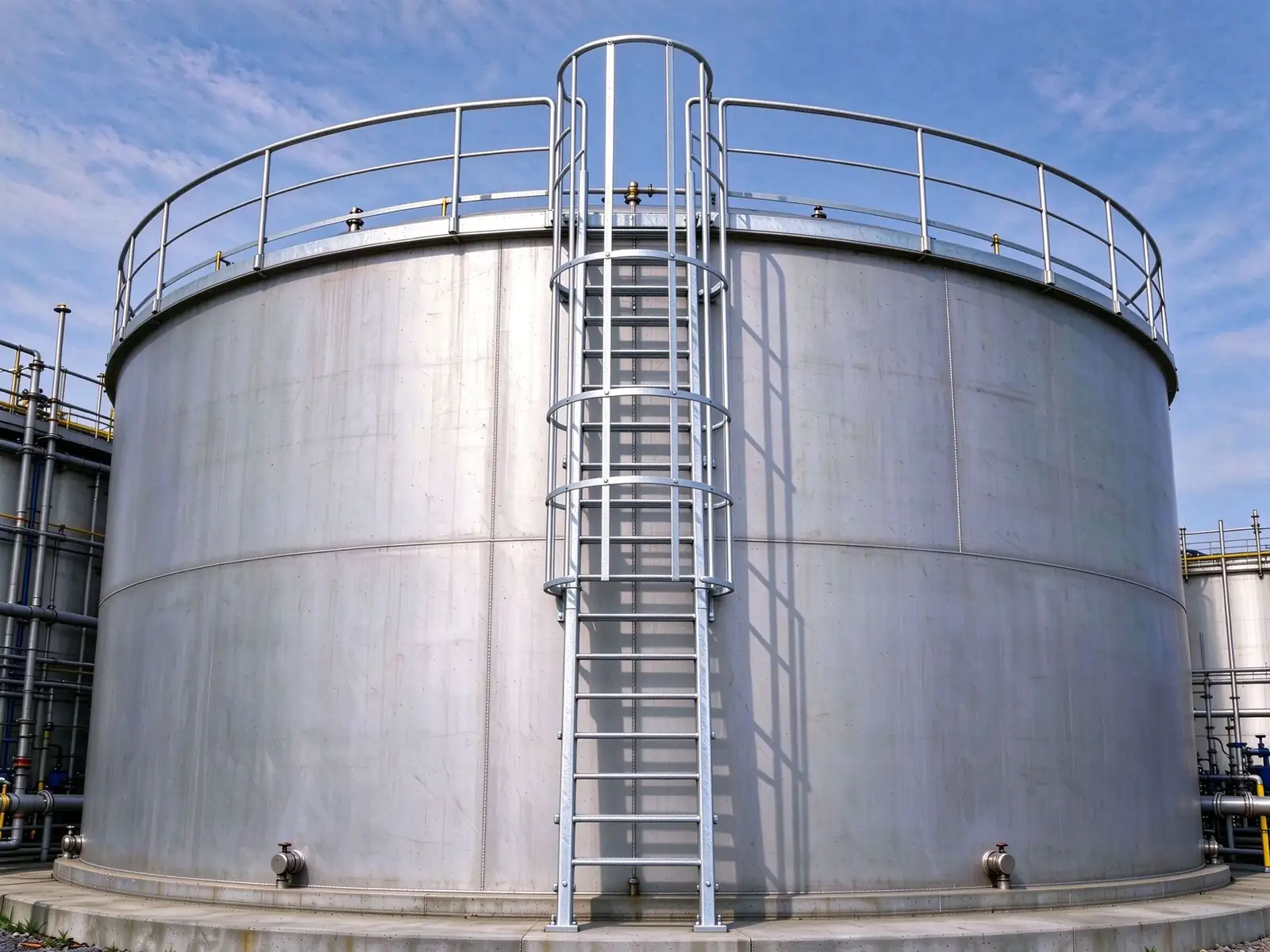
caged ladder safety cage construction explained in DengTAI knowledge base
Quick Answer

DengTAI knowledge base answers 50 common questions about caged ladders: materials (carbon steel, galvanized, aluminum, stainless, FRP), standards (OSHA, EN ISO, BS, AS, GB), dimensions, applications, pricing, shipping and factory information.

Basic definitions

What a caged ladder is, how the cage works, and when it's required.

What is a caged ladder?
A caged ladder is a fixed vertical ladder fitted with a full-height safety cage of curved hoops and vertical guards surrounding the climber. It is used on tanks, silos, buildings and industrial structures where a worker must climb 3–7 m or more. The cage prevents outward falls while allowing normal climbing movement.
What is the cage around a ladder called?
It is commonly called a ladder safety cage, cage guard, ladder hoops. OSHA refers to it as a "cage" or "well". In British/Australian practice: "cage" or "well". In Chinese engineering it is called hù lóng (护笼).
How does a ladder safety cage work?
It acts as passive fall restraint. If a worker slips, their body naturally meets the cage wall — hoops and vertical guards spaced ≤300 mm prevent the climber from falling outward. No active harness or training is required for the cage itself.
Are ladder cages effective?
Yes for preventing fatal falls on fixed vertical climbs. They remain the primary fall-protection method under GB 4053.1, EN ISO 14122-4, BS 4211 and AS 1657. For new US installations, OSHA now prefers LSS/PFAS over cages alone — but cages are still accepted for existing ladders and most global markets.
Why do some ladders have cages?
Mandated when a fixed ladder exceeds the cage-free height limit — typically 3 m under EN/CN standards, 6.1–7.3 m under OSHA. Required on tanks, silos, roof access, water towers and any structure where a fall would cause serious injury.
Is a ladder cage considered fall protection?
Under GB, EN, BS and AS standards, yes — a cage is accepted passive fall protection. Under current OSHA, a cage is NOT considered adequate fall protection for new ladders over 7.3 m; those require a Ladder Safety System (LSS) or Personal Fall-Arrest System (PFAS).
What alternatives exist if no cage?
Standards typically require: (1) Ladder Safety System — vertical rail with sleeve/cable; (2) Personal Fall-Arrest harness anchored to the ladder; (3) rest platform combined with fall protection. For new OSHA-compliant ladders over 7.3 m, LSS is the default.
What is the difference between Type 1/2/3/4 ladder?
Type 1 — plain fixed ladder (below cage-free height); Type 2 — caged ladder (standard for most tank/roof access); Type 3 — caged ladder with top handrail extending 1.1 m above platform; Type 4 — caged ladder with intermediate rest platforms for tall climbs (>6–10 m).

Material selection

Which of our five materials fits your environment, budget and destination.

Which material is strongest?
For fixed vertical access, hot-dip galvanized steel offers the best strength-to-cost ratio (Q235B, 235 MPa yield strength, 4 kN rung load). For coastal or chemical environments, upgrade to stainless SS316L or FRP fiberglass — both outlast painted carbon steel.
When to choose carbon steel powder-coated?
Carbon steel, powder-coated for indoor, dry environments, budget-sensitive projects, and when custom color matching is needed. Most economical option; not recommended for outdoor or humid exposure.
When to choose hot-dip galvanized?
Hot-dip galvanized for outdoor / general industry — 70–85 µm zinc coating per EN ISO 1461, provides 15–20 years rust protection. The default choice for tanks, silos, roof access and steel structures.
When to choose aluminum 6063?
Aluminum 6063 for lightweight, no painting, food plants, building facades, roof access, non-sparking requirements. T5 temper; easy to transport and install on existing walls.
When to choose stainless SS304 vs SS316L?
SS304 for general food/indoor/dry; SS316L for coastal chloride, chemical, marine environments — the molybdenum addition (2–2.5%) significantly improves pitting corrosion resistance.
When to choose FRP fiberglass?
FRP / fiberglass for explosion-proof, non-conductive, chemical tanks, power stations, salt-spray areas. Pultruded profiles; zero maintenance; never rust.
Can I mix materials on one project?
Yes — e.g. SS304 for tank top (chloride atmosphere), HDG for wall sections (general), FRP for chemical area (acid exposure). We engineer per location, not per whole site.
What is the price difference between materials?
Approximate FOB Tianjin relative pricing: carbon powder-coated = baseline; HDG +20–30%; aluminum +50–80%; SS304 +80–120%; SS316L +120–180%; FRP +60–100%.

Standards & compliance

OSHA, EN, BS, AS, GB — which one applies to your destination market.

What are OSHA ladder cage requirements?
OSHA 1910.28 requires: rung spacing 254–356 mm (10–14 in), cage width 686–762 mm (27–30 in), hoop spacing ≤1.2 m (4 ft), rest platform every 15.2 m (50 ft), side rails extend 1.07 m (42 in) above platform, rear clearance ≥180 mm (7 in). New ladders over 7.3 m also require fall-arrest system.
What is EN ISO 14122-4?
EU standard for fixed ladder access to machinery; cage required from 3 m climb height; cage diameter 650–800 mm; hoop spacing ≤1500 mm; rest platforms every 6 m. See technical details.
What is BS 4211?
UK standard for steel ladders and stairs for building maintenance, largely aligned with EN ISO 14122-4. Covers design, materials and installation for permanent vertical access.
What is AS 1657?
Australia/NZ standard for fixed platforms, walkways and ladders. Cage diameter ≥850 mm (wider than US/EU); rest platforms mandatory above 6 m.
What is GB 4053.1 / 15J401?
GB 4053.1-2016 is the Chinese safety standard for fixed steel ladders. Atlas 15J401 (pages 129–154, D1–D26) is the standard structural drawing collection detailing dimensions, materials and connections.
Which standard does DengTAI certify to?
CE + ISO 9001 certified. We build to GB 4053.1 by default, and can match OSHA / EN ISO 14122-4 / BS 4211 / AS 1657 per your destination market.
Do you provide mill certificates / inspection reports?
Yes — mill certificates, weld reports, coating thickness logs (magnetic gauge), rung load tests on every unit. Third-party inspection by SGS / TÜV / BV available on request.

Technical specifications

Dimensions, materials, load ratings and lead times.

What is the standard rung spacing?
250–300 mm under GB/EN; 254–356 mm (10–14 in) under OSHA. Round-bar rungs Ø25–30 mm with slip-resistant surface.
What is the cage diameter?
Typical 650–800 mm; OSHA requires 686–762 mm; AS 1657 requires ≥850 mm. Custom diameters available per drawing.
What load rating do rungs support?
1.5 kN (EU) / 2.5 kN (US) / 4 kN (GB) single-rung concentrated load rating.
How tall can a single ladder section be?
≤6 m (EN/OSHA) before rest platform required; ≤10 m (GB WT3). Modular sections bolted on site.
What side rail material / size?
Q235B flat bar ≥60×10 mm; L70×6 angle supports for wall mounting; aluminum 6063-T5 extrusion for aluminum ladders.
Can height / width be customized?
Yes — any height, cage diameter, mounting type (wall/tank/silo/roof), per your drawing. No standard SKU; every unit is engineered to spec.
What is the typical lead time?
15–25 days after drawing confirmation + deposit; 48-hour quote turnaround. Samples within 10 days.

Application scenarios

Where caged ladders go, and which material fits each environment.

Where are caged ladders typically used?
Tanks/silos, water/wastewater plants, buildings/roof access, power/substations, ports/cranes, agriculture silos, communication towers, industrial plants. See full application list.
Which material for water treatment plants?
HDG for general outdoor structures; SS304 for clarifiers and pumping stations exposed to chloride.
Which material for chemical plants?
FRP (non-conductive, acid-resistant, explosion-proof) for acid process vessels; SS316L for organic solvent tanks.
Which material for coastal / marine?
SS316L is best; HDG with thicker zinc (≥85 µm) as budget option. Avoid carbon powder-coated — it will blister within 1–2 years.
Can a caged ladder be installed on a tank?
Yes — U-clamp on tank wall, no drilling through shell; top platform on tank roof with guardrails.
Can it go through a roof hatch?
Yes — top handrail + guardrail at hatch opening; cage terminates 1.1 m above roof per EN/BS.

Quoting & purchasing

What we need, price ranges, payment terms and MOQ.

What information do you need for a quote?
(1) Height of ladder; (2) cage width/diameter; (3) mounting type (wall/tank/silo/roof); (4) material choice; (5) destination standard (OSHA/EN/BS/AS/GB); (6) quantity; (7) port of discharge. Send via quote form.
What is the price range?
Approximate FOB Tianjin, USD: Type 1 $250–800, Type 2 $500–1,200, Type 3 $650–1,500, Type 4 $900–2,800. Final price depends on height, material, coating and quantity.
Do you accept custom drawings?
Yes — send your drawing or dimensions; we return layout + material confirmation + FOB price within 48 hours.
What payment terms?
30% T/T deposit, 70% before shipment; L/C at sight for orders over $50,000.
Can you do small quantity / sample?
Yes — MOQ 1 unit; sample production within 10 days. Sample cost refundable on bulk order.

Installation & shipping

How we pack, ship from Tianjin Port, and support installation.

How is the ladder shipped?
Knock-down (KD) sections — side rails, hoops, rungs packed flat in plywood cases; container-loaded from Tianjin Port (~300 km from factory).
Do you provide installation guidance?
Yes — PDF installation drawings + bolt-up manual included. On-site engineer available for overseas projects (extra cost).
What Incoterms do you support?
EXW, FOB Tianjin, CIF, DAP; most export orders are FOB Tianjin.
How long does sea shipping take?
Tianjin to US West Coast ~16–20 days, Europe ~30–35 days, SE Asia ~7–12 days, Middle East ~18–25 days.
Can you handle customs documentation?
Yes — commercial invoice, packing list, BL, CE/ISO certs, origin certificate. HS code: 7326.90 (steel) / 7610.50 (aluminum).

Company & factory

Where we are, how we produce, and where we've shipped.

Where is DengTAI factory?
Jingxing Mining Area, Shijiazhuang, Hebei, China — approximately 300 km from Tianjin Port. See company profile.
What is your production capacity?
3,000 m² workshop, 3 production lines, 50+ skilled workers, daily output over 240 meters of ladder.
What certifications do you hold?
CE, ISO 9001. Products follow GB 4053.1-2016 and reference atlases 15J401 / 02J401.
Which countries have you exported to?
Cambodia (largest water plant, SS304), Australia, SE Asia (Singapore/Malaysia/Thailand), Middle East (Saudi/UAE), plus domestic metro, highway and water projects across China. See case studies.

Your question not answered here?

Send it to our engineer. We reply within one working day, with standards references if needed.

Ask a Question

References: OSHA 1910.28 · EN ISO 14122-4 · ISO 9001

Last updated: · DengTAI Stair Manufacturing Co., Ltd. · Shijiazhuang, Hebei, China