Stainless Steel Caged Ladder
A fixed SS304/316 stainless steel ladder with a full-height safety cage — inherently corrosion-resistant, no coating to fail. The premium vertical access for food, pharmaceutical, coastal, chemical and hygienic facilities worldwide.
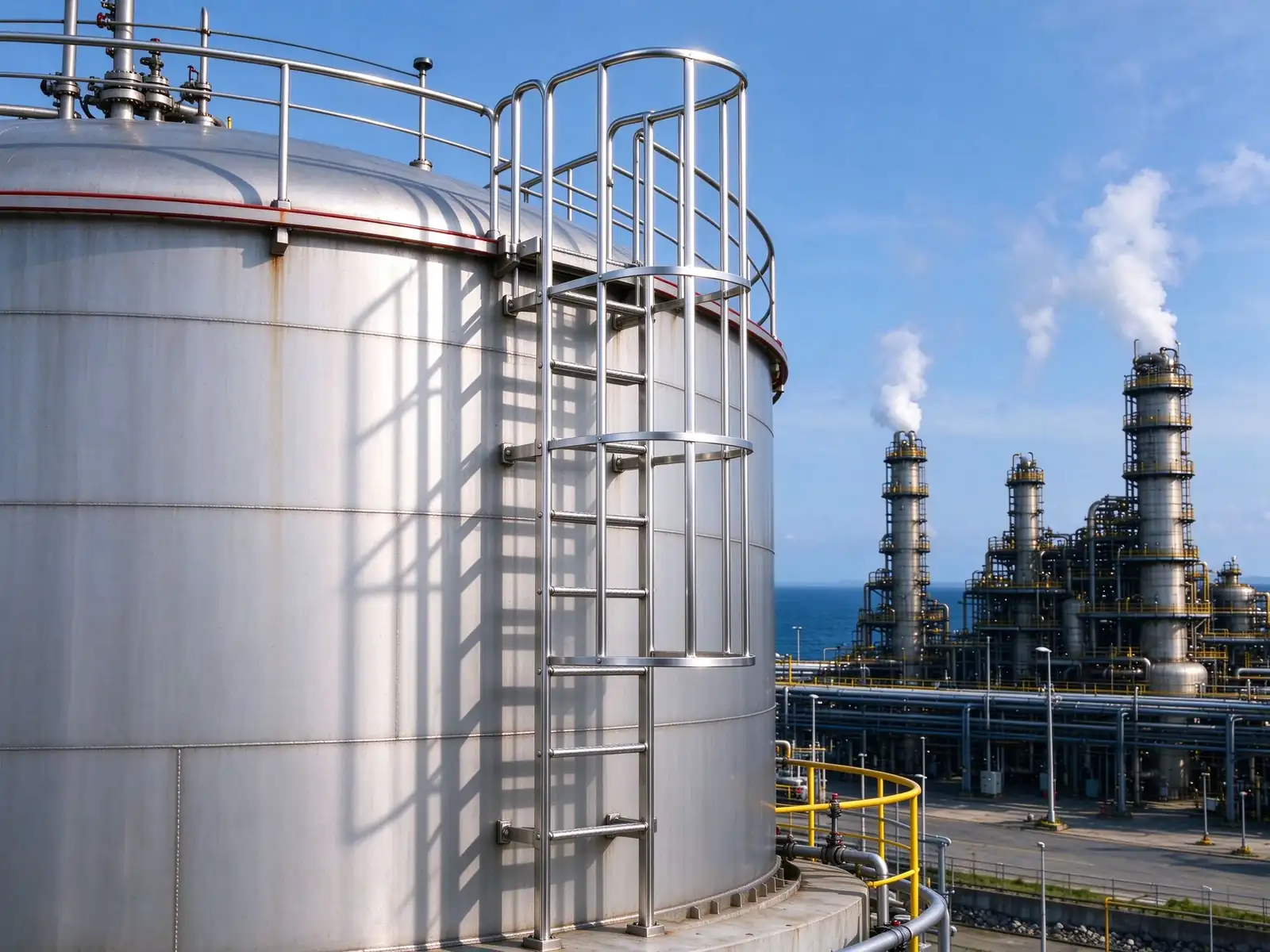
Stainless steel caged ladders are SS304/SS316 fixed ladders with a full-height safety cage. Inherently corrosion-resistant, no coating to fail. The premium choice for food, pharmaceutical, coastal, chemical and hygienic facilities.
What It Is, Why It’s Safer, How We Build It, When You Need It
A DengTAI guide to the stainless steel caged ladder — where it is used, why it matters for hygiene and safety, how we manufacture it, and when a cage is required.
1What is it?
An industrial vertical-access solution combining a fixed SS304/316 stainless steel ladder with a full-height safety cage of hoops and vertical guards. We build it for the most demanding working sites — food and beverage plants, pharmaceutical GMP areas, water treatment and coastal facilities — where hygienic, corrosion-proof access is essential. Stainless steel needs no coating, so there is no rust, flaking or re-painting to manage.
2Why it matters for your workers
This is the fall-protection safeguard that keeps your people safe on high climbs. With a 700–900mm cage engineered to enclose a worker wearing full fall-arrest gear, 360° protection and vertical guard spacing ≤18", the cage works as a passive restraint: if a worker slips, their body meets the cage wall and a fatal fall is prevented. Fewer accidents, safer operation and less downtime for your project.
3How DengTAI builds it
As an in-house manufacturer we control every stage under one roof — cutting, TIG welding, grinding, pickling/passivation and assembly. Side rails (60×10mm flat bar), rungs (20mm round bar at 250–300mm spacing) and the cage of hoops and vertical members are full-penetration TIG welded in stainless. Fixed and modular height-adjustable systems are both available.
4When you need it
Whenever a fixed ladder exceeds the cage-free height limit — typically 3–7m depending on the standard — or your site (tanks, silos, roofs, plant structures) poses a serious fall risk. We also add intermediate rest platforms on tall climbs and supply caged access for retrofit, maintenance and safety upgrades.
Why Our Stainless Steel Caged Ladder Stands Apart
Every detail is engineered for hygiene, corrosion resistance and worker safety — delivered as a complete vertical access solution. These are the attributes that set DengTAI stainless steel caged ladders apart on site.
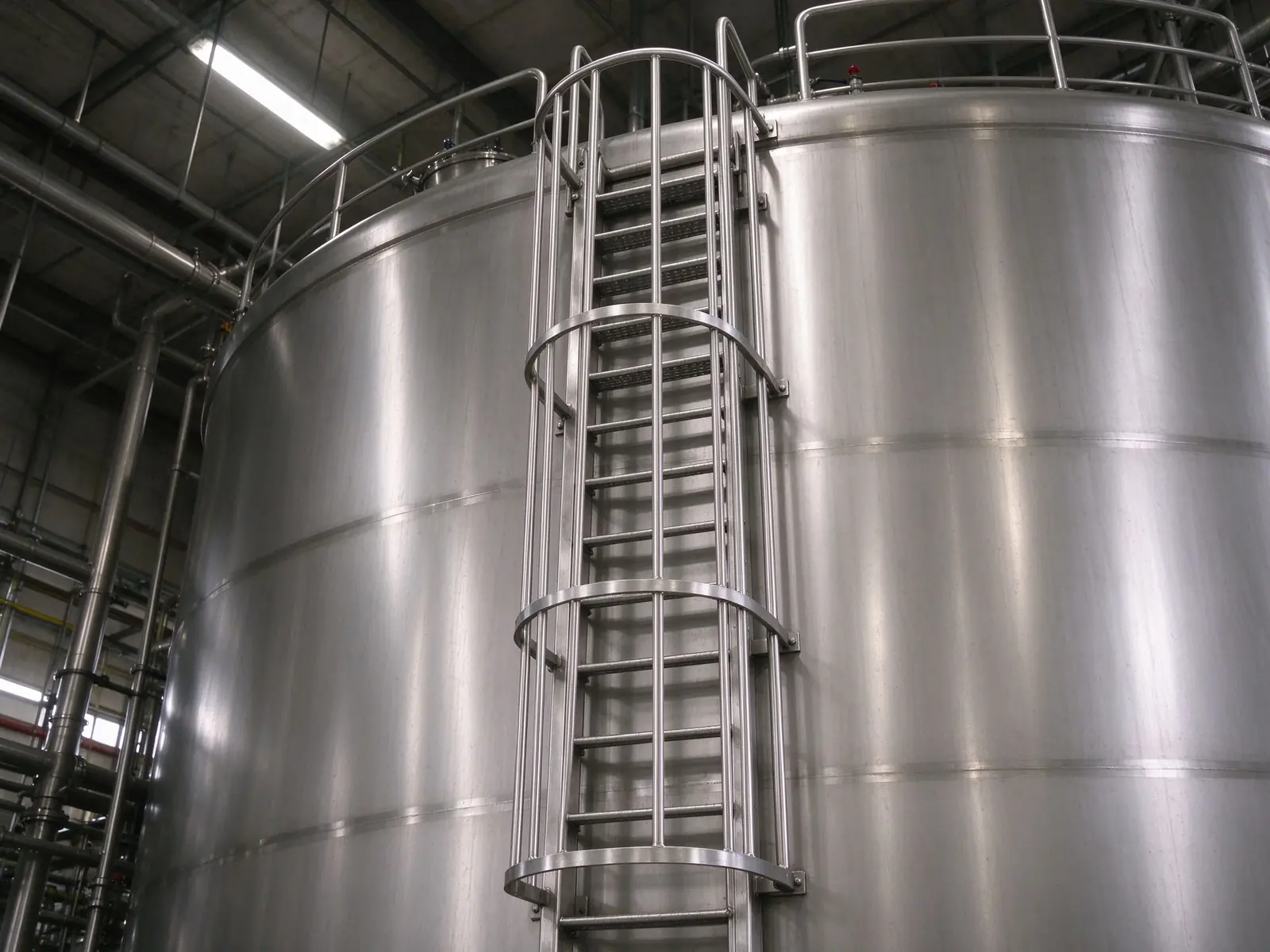
Inherent Corrosion Resistance
SS304/316 stainless steel resists rust by itself — no coating to chip, flake or fail. The chromium passive film self-heals, so edges, welds and cut surfaces stay protected for decades, and there is no re-painting or coating maintenance.
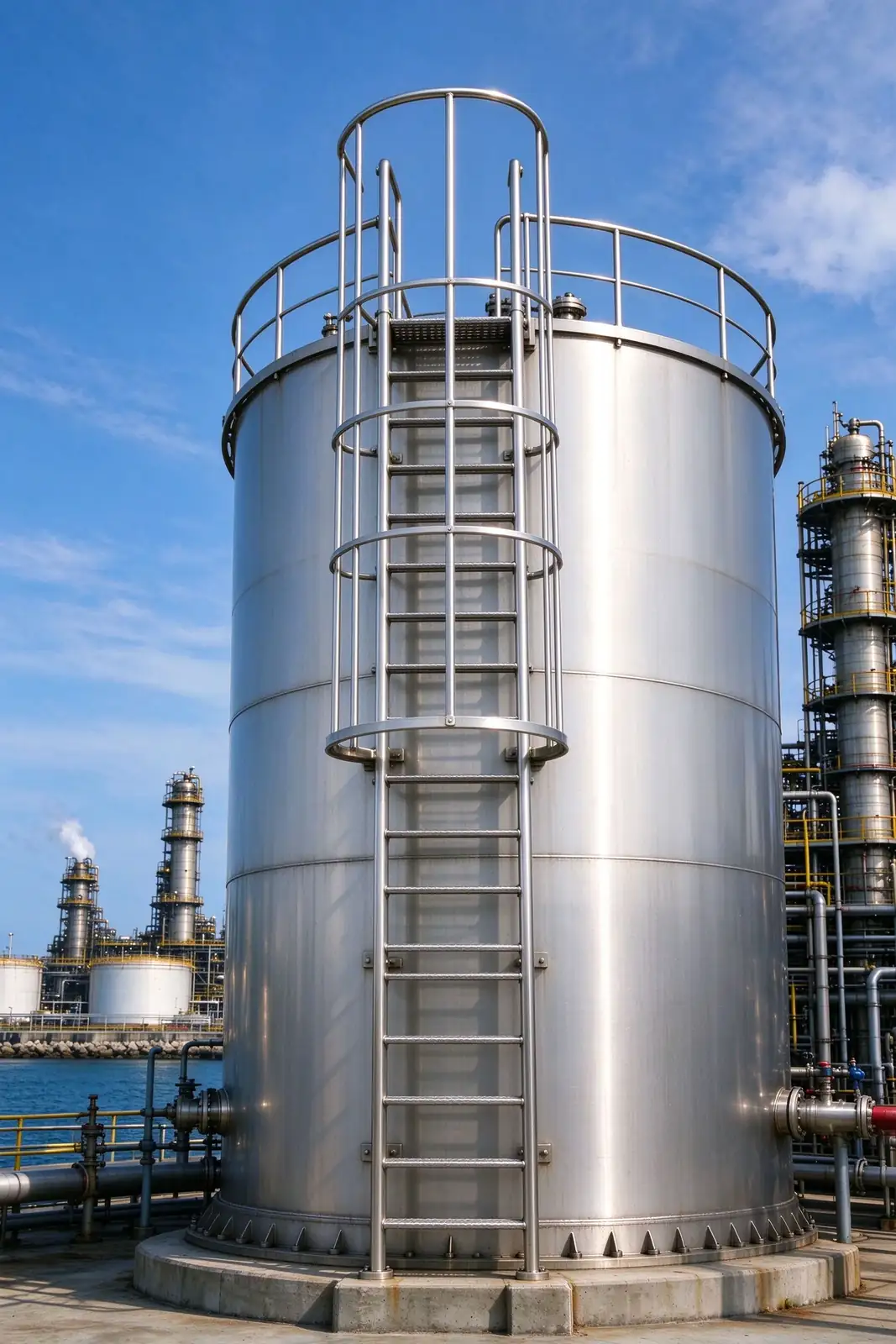
High Strength & Durability
Stainless steel delivers high strength with excellent toughness. Side rails ≥60×10mm flat bar and full-penetration TIG-welded joints give dependable structural integrity for daily industrial and hygienic use.
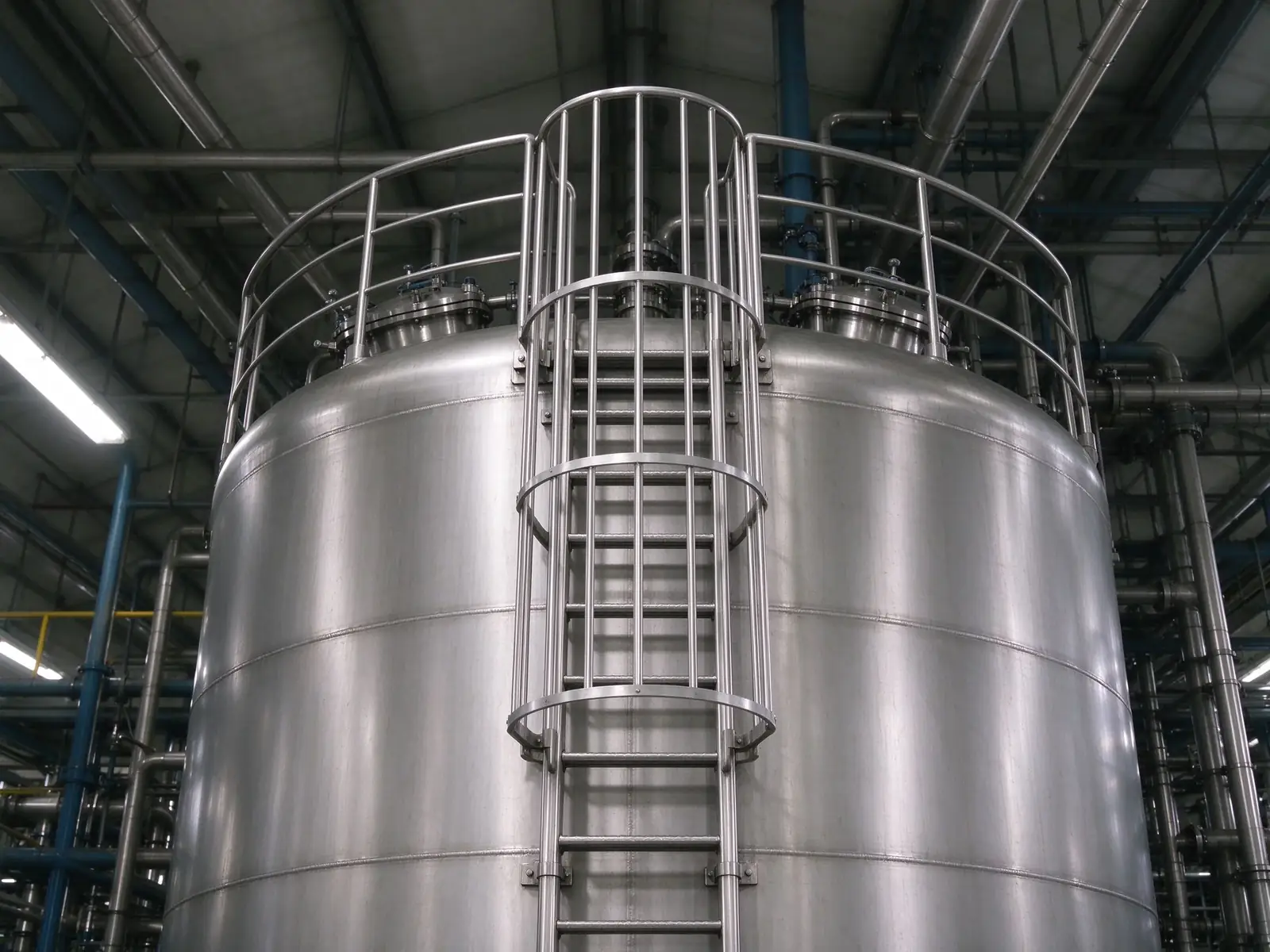
Full-Height Safety Cage
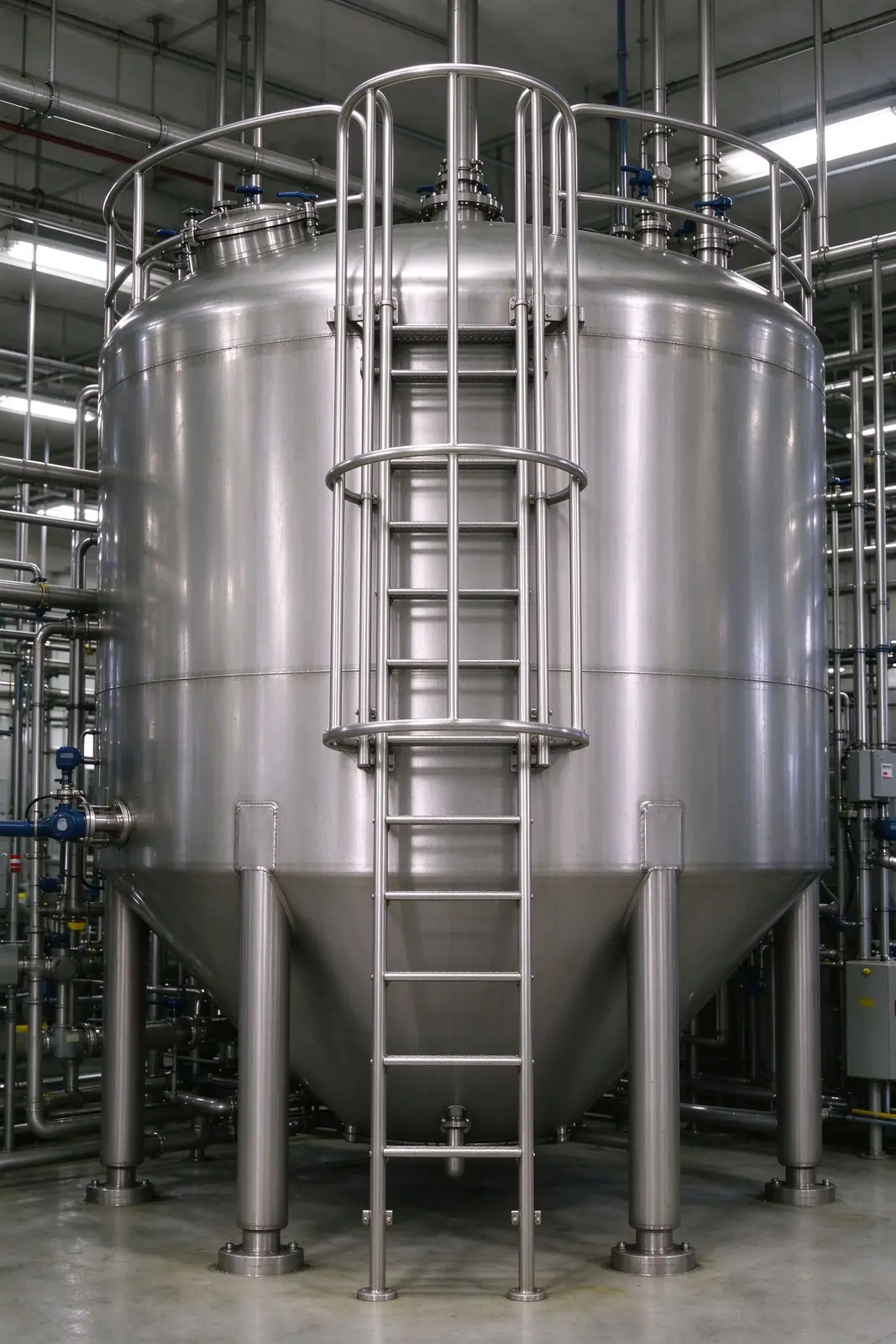
Hoops and vertical guards surround the climber from 2.1–2.4m above ground to 1.1m above the platform, preventing accidental falls. 360° coverage with vertical guard spacing ≤18" (240–300mm) keeps the worker enclosed on every step.
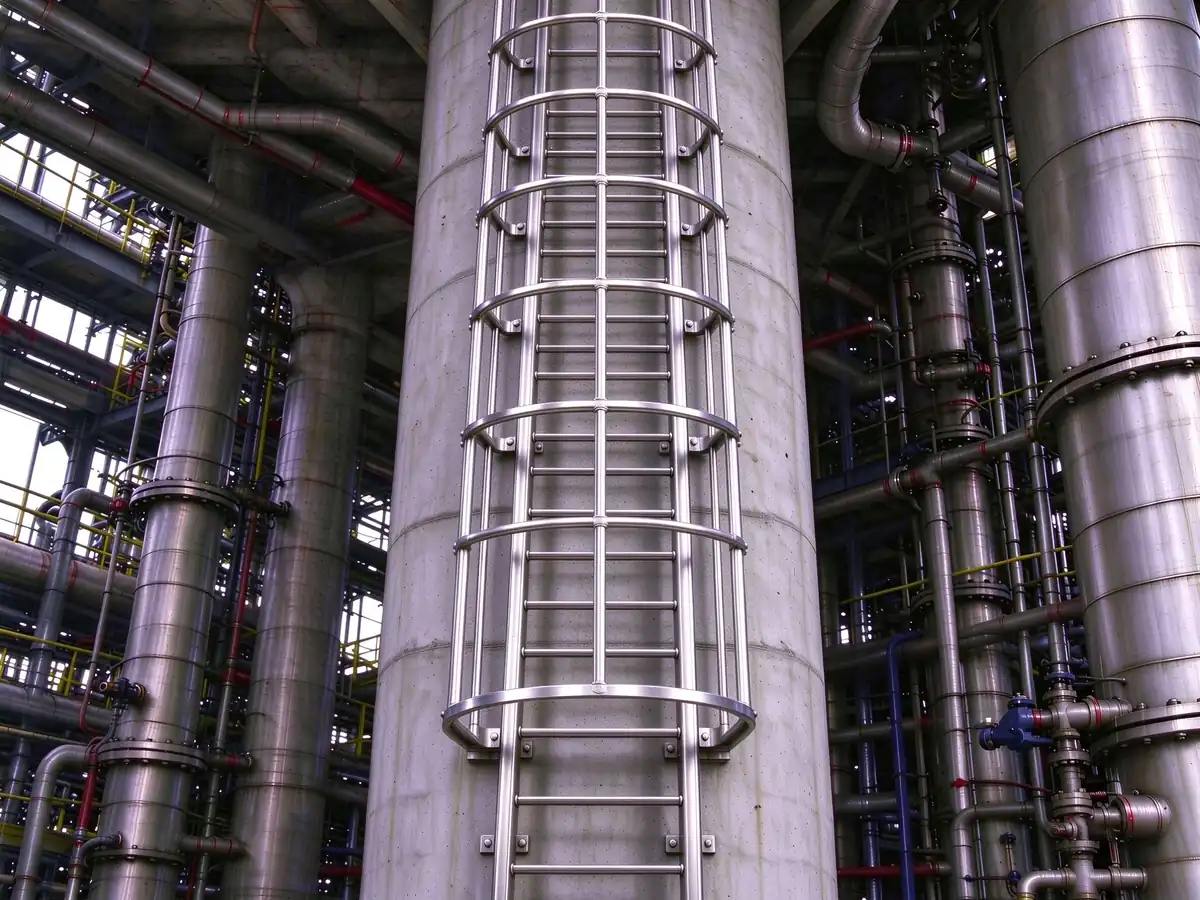
Slip-Resistant Rungs & Even Spacing
25mm round-bar rungs with a slip-resistant surface at 250–300mm spacing give a comfortable, steady climb. Consistent rung pitch reduces fatigue on tall climbs and improves worker grip and confidence.
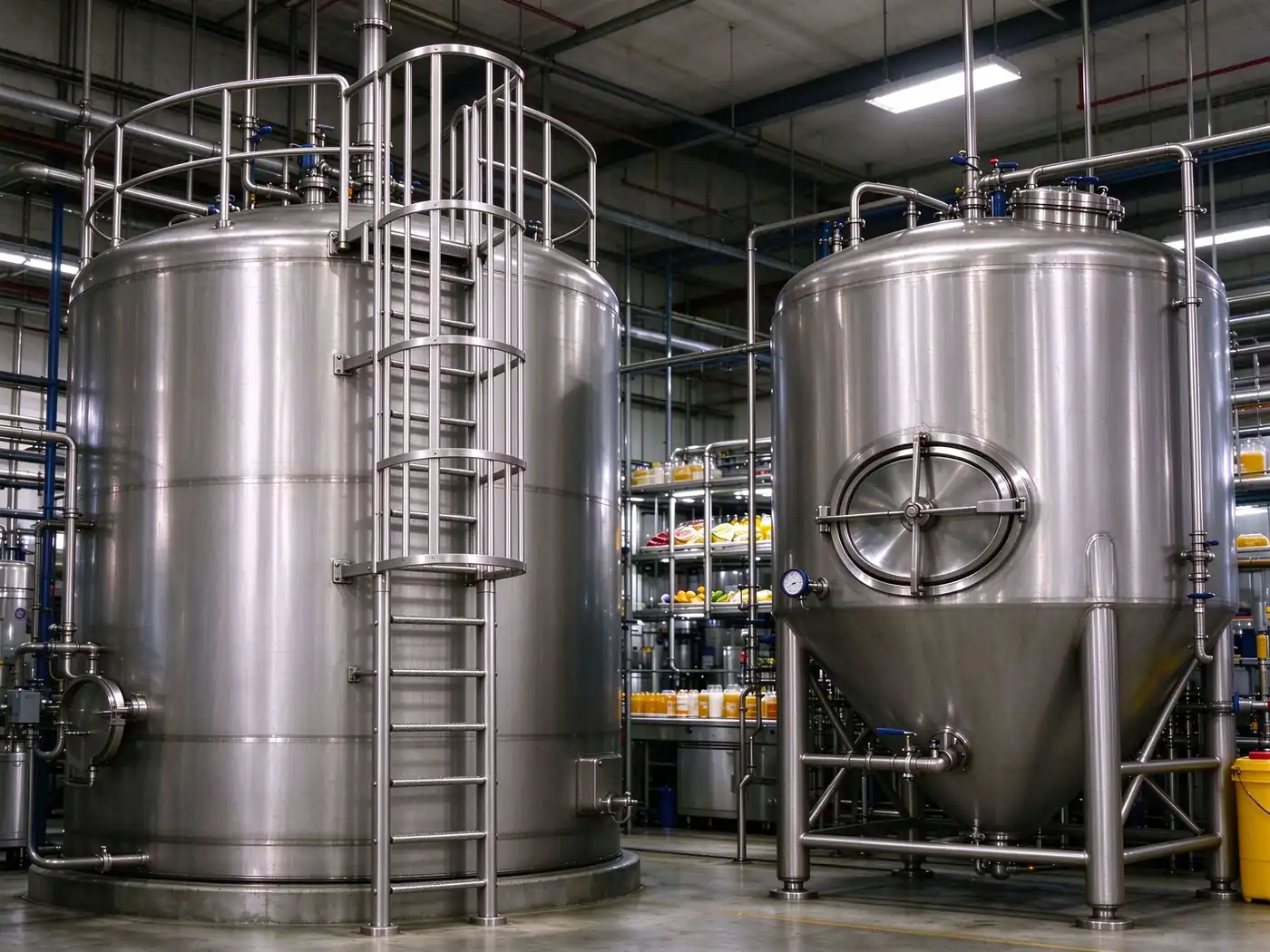
Passive Fall Restraint
The cage works as a passive restraint: if a worker slips, their body naturally meets the cage wall and a dangerous fall is stopped. Together with correct 75–90° installation, it protects climbers on every ascent.
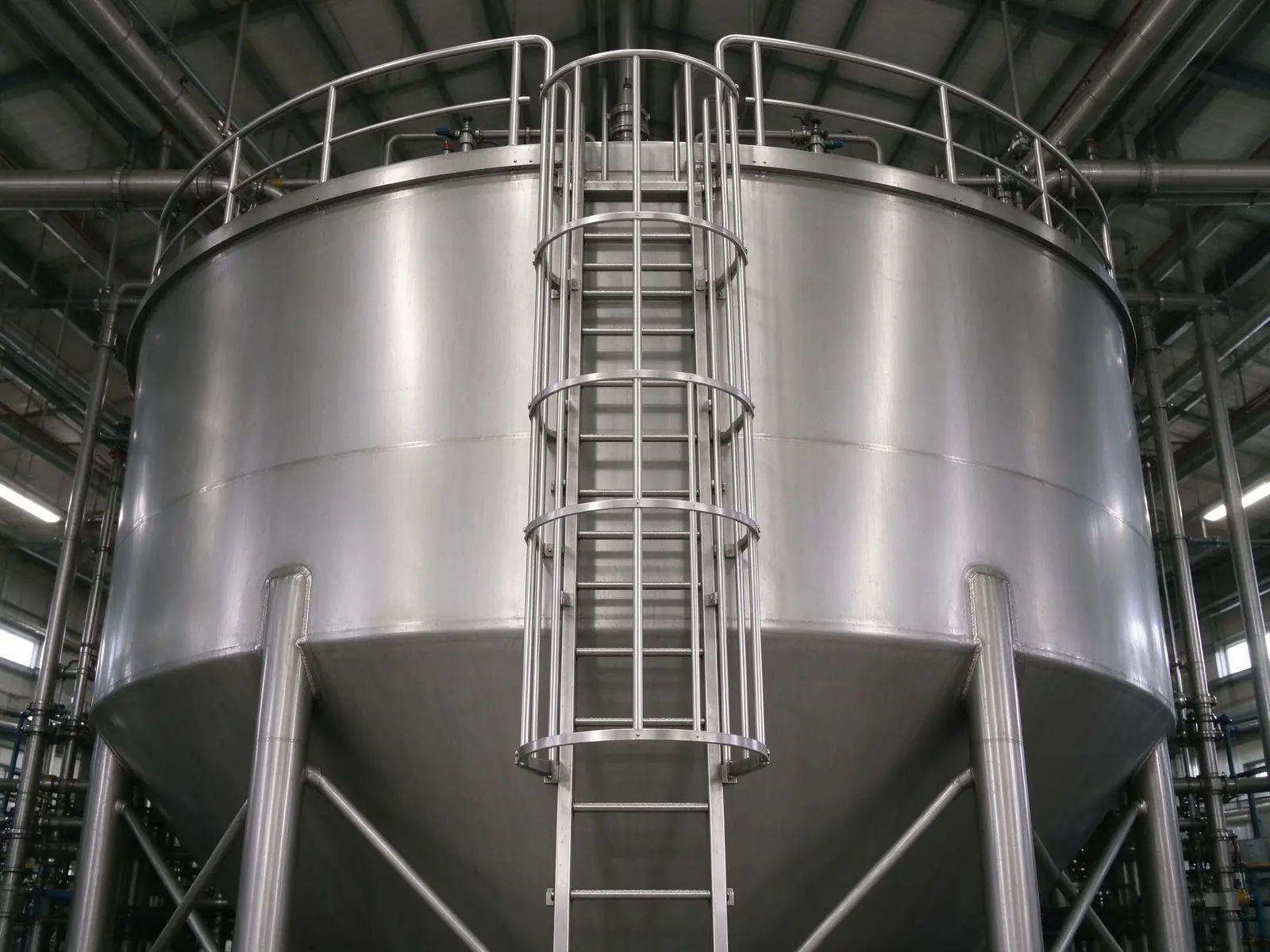
Global Standard Compliance
Engineered to OSHA 1910.28, EN ISO 14122-4, BS 4211, AS 1657 and GB 4053.1 — certified cage geometry and fall protection for your destination market, with stainless steel hygiene to GMP where required.
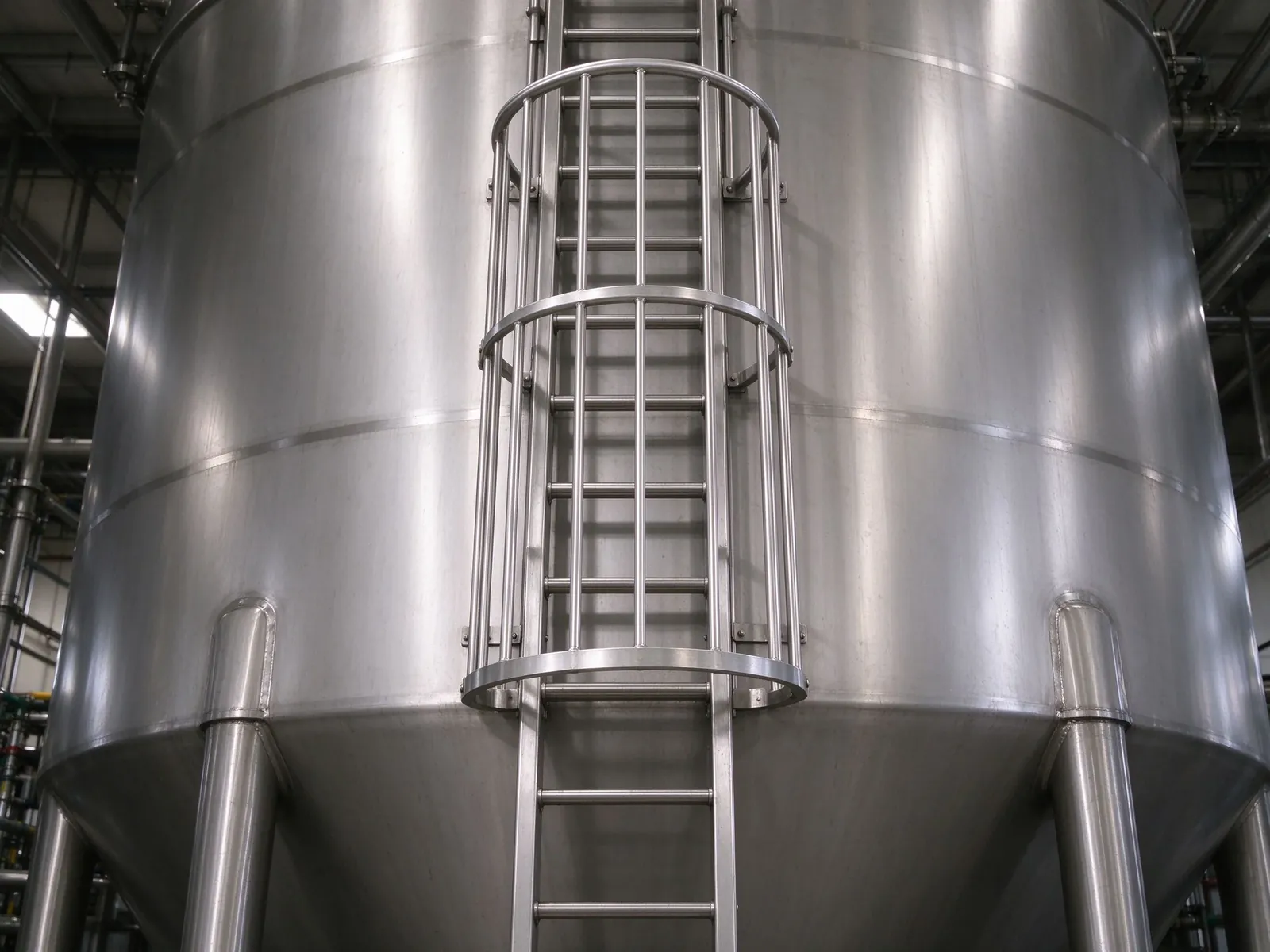
Custom Height & Mounting
Made to your drawing or dimensions — wall, tank, silo or roof mounting with L70×6 angle supports, per your site base. Fixed and modular height-adjustable systems cover every access need.
Intermediate Rest Platforms
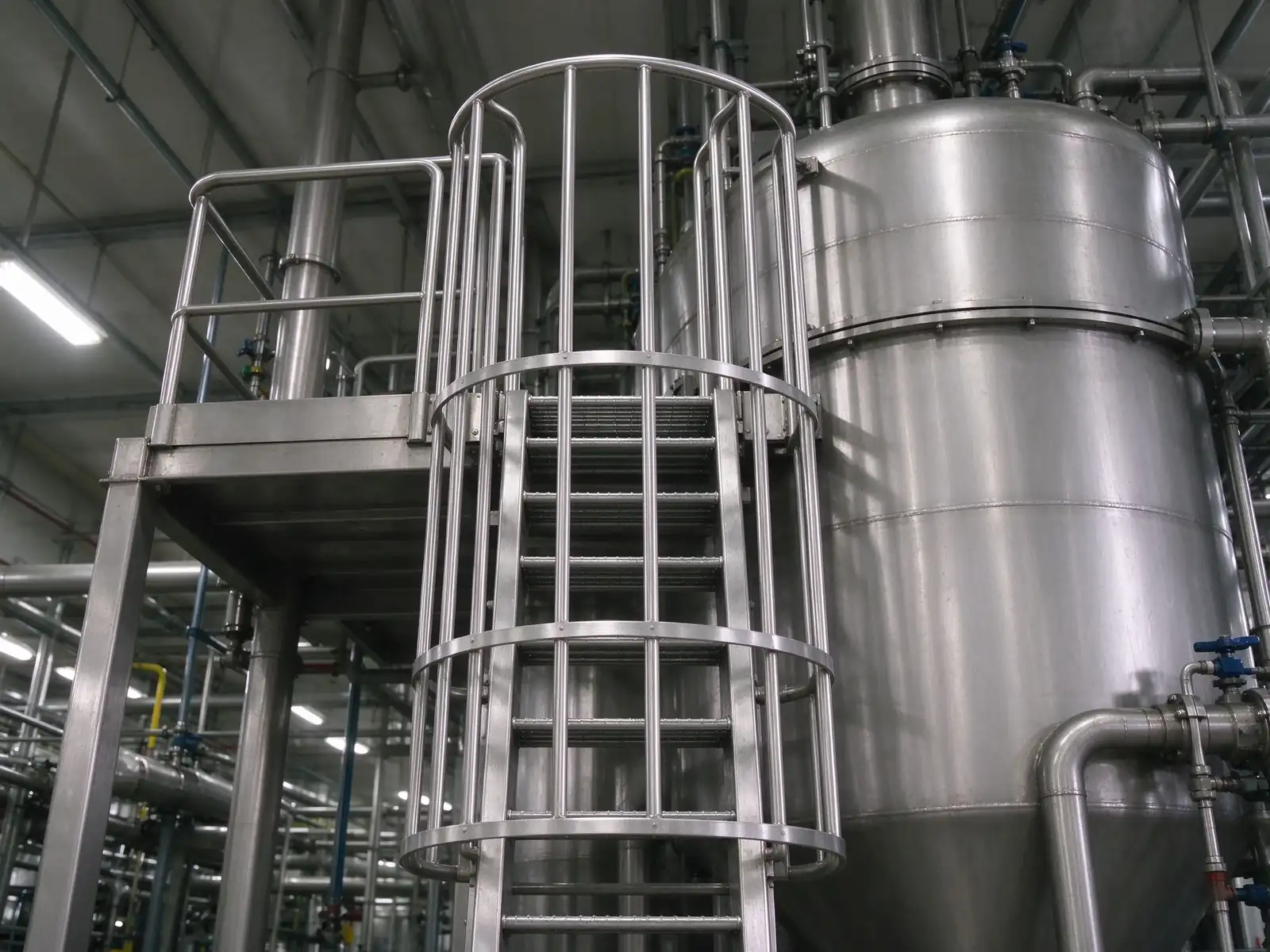
For tall climbs, we add intermediate rest platforms that split the ascent and give workers a safe step-off point. This reduces fatigue and supports OSHA / EN rest-stop requirements.
Traceable Quality & Testing
Mill certificates (heat number traceable), weld inspection, surface finish checks and rung load tests on every unit. Third-party inspection by SGS / TÜV / BV is available to back your compliance documentation.
Stainless Steel — 304 vs 316L: Which Grade Do You Need?
Stainless steel is the premium choice for corrosive environments — coastal, chemical, food & pharma. But not all stainless is equal. Choosing the right grade matters: too light and it rusts; too heavy and you overpay 40%.
304 (18/8) — General Purpose:
- Chromium 18% + Nickel 8%
- ✅ Indoor, food processing, clean environments
- ✅ Urban / mild outdoor use
- ⚠️ Not for direct coastal exposure — will develop surface rust in 2-3 years
- 💰 Cost: baseline reference
316L — Marine / Chemical Grade:
- Chromium 16% + Nickel 10% + Molybdenum 2% — the key difference
- ✅ Coastal / marine environments — salt air resistance
- ✅ Chemical plants, wastewater treatment
- ✅ Pharmaceutical / high-purity applications
- ✅ Welded constructions (L = low carbon, better weld resistance)
- 💰 Cost: +30-40% over 304
Common mistakes to avoid:
- ❌ Using 304 on the coast — it will rust, guaranteed. Upgrade to 316L.
- ❌ Using 316L for indoor food plants — overkill. 304 is fine and saves 35%.
- ❌ Forgetting that stainless STILL rusts in severe acid — choose FRP for that.
DengTAI recommendation:
When in doubt, ask us: tell us your environment and we'll recommend the right grade. We can also do hybrid designs — 304 for the upper sections (less exposed) and 316L for the lower 2 meters (most exposed to splashes and salt spray). This saves money without compromising durability.
Common Applications of Stainless Steel Ladders
Best use cases:
- 🌊 **Coastal & marine environments** — piers, offshore platforms, coastal water treatment plants. 316L resists salt spray perfectly.
- 🏭 **Food & beverage plants** — breweries, dairies, processing plants. Stainless is easy to clean, hygienic, and doesn't leach into food.
- 💊 **Pharmaceutical & cleanrooms** — GMP-compliant, non-particle-shedding, easy to sterilize.
- 💧 **Water & wastewater treatment** — clarifiers, pump stations, chlorination buildings. Moisture and chemicals won't corrode it.
- 🏭 **Chemical plants (mild chemicals)** — dilute acids, alkalis, and process water. For strong acids, choose FRP instead.
Why stainless for these applications:
Stainless steel is the "hygiene material" — it doesn't need paint or coating, so there's nothing to chip, peel, or contaminate the product. It's easy to wash down with high-pressure cleaners and disinfectants. And it looks great — no rust spots, no peeling paint, just clean silver metal that stays looking new for decades.
Surface finish options:
- **Mill finish (2B):** Standard, matte silver. Most cost-effective. Good for industrial use.
- **Brushed finish:** Satin look, hides scratches. Popular for food plants and buildings.
- **Mirror polish (8K):** High-gloss. Used in cleanrooms, pharma, and architectural projects where appearance matters.
Dimensions, Weight & Surface Area
Standard engineering values per EN ISO 14122-4 / GB 4053.1. Custom heights, cage diameters, weights and quantities are provided with your quotation.
| Product Type | Fixed vertical stainless steel ladder (SS304/316) with safety cage / hoops |
|---|---|
| Base Material | SS304 / SS316 stainless steel (304 general corrosion · 316 for chlorides & sea air) |
| Surface Finish | Stainless steel — brushed / pickled & passivated; mirror polish optional for hygienic zones |
| Side Rails | Flat bar ≥60×10mm, two rails |
| Rungs | Round bar ø20–30mm, slip-resistant, spacing 250–300mm |
| Rung Load | 1.5kN (EU) / 250lb≈1.1kN (US) single-rung load |
| Cage Diameter | 650–800mm (custom) |
| Cage Hoops | Flat bar ≥50×6mm, spacing 1200–1500mm |
| Cage Uprights | Flat bar ≥40×5mm vertical guards |
| Cage Start / Top | Starts 2.1–2.4m above ground; extends 1.1m above platform |
| Wall Clearance | ≈178mm (7") from rungs to wall |
| Weight / Area | Calculated per model & height in your quotation (kg per meter, stainless surface area) |
| Mounting | Wall, tank, silo or roof supports — L70×6 angle brackets |
| Standards | GB 4053.1 / OSHA 1910.28 / EN ISO 14122-4 / BS 4211 / AS 1657 |
Global Price Range (USD)
Indicative FOB price ranges by configuration, in US dollars. Final pricing is per your drawing, height, quantity and destination — confirmed in your quotation.
| Configuration | Typical Height | Global Price Range (USD) |
|---|---|---|
| Type 1 — Fixed Ladder | 3 – 6 m | $250 – $600 |
| Type 2 — Caged Ladder | 3 – 10 m | $500 – $1,200 |
| Type 3 — Caged Ladder with Top Handrail | 3 – 10 m | $650 – $1,500 |
| Type 4 — Fixed Ladder with Safety Cage, Intermediate Rest Platforms (Landings) and Guardrails | up to 15 m+ | $900 – $2,800 |
Prices are in USD, indicative ranges only — actual quotes depend on stainless grade (304/316), height, accessories and freight. Contact us for an exact FOB price.
Four Configurations for Every Access Need
From a plain fixed ladder to a full caged system with handrail and platform. The right type is selected by your working height and regional standard — we show the standard cage threshold for each.
Fixed Ladder
A simple vertical ladder with two rails and rungs, used where height stays below the cage-free limit. Ideal for short access inside plants, basements and pump rooms.
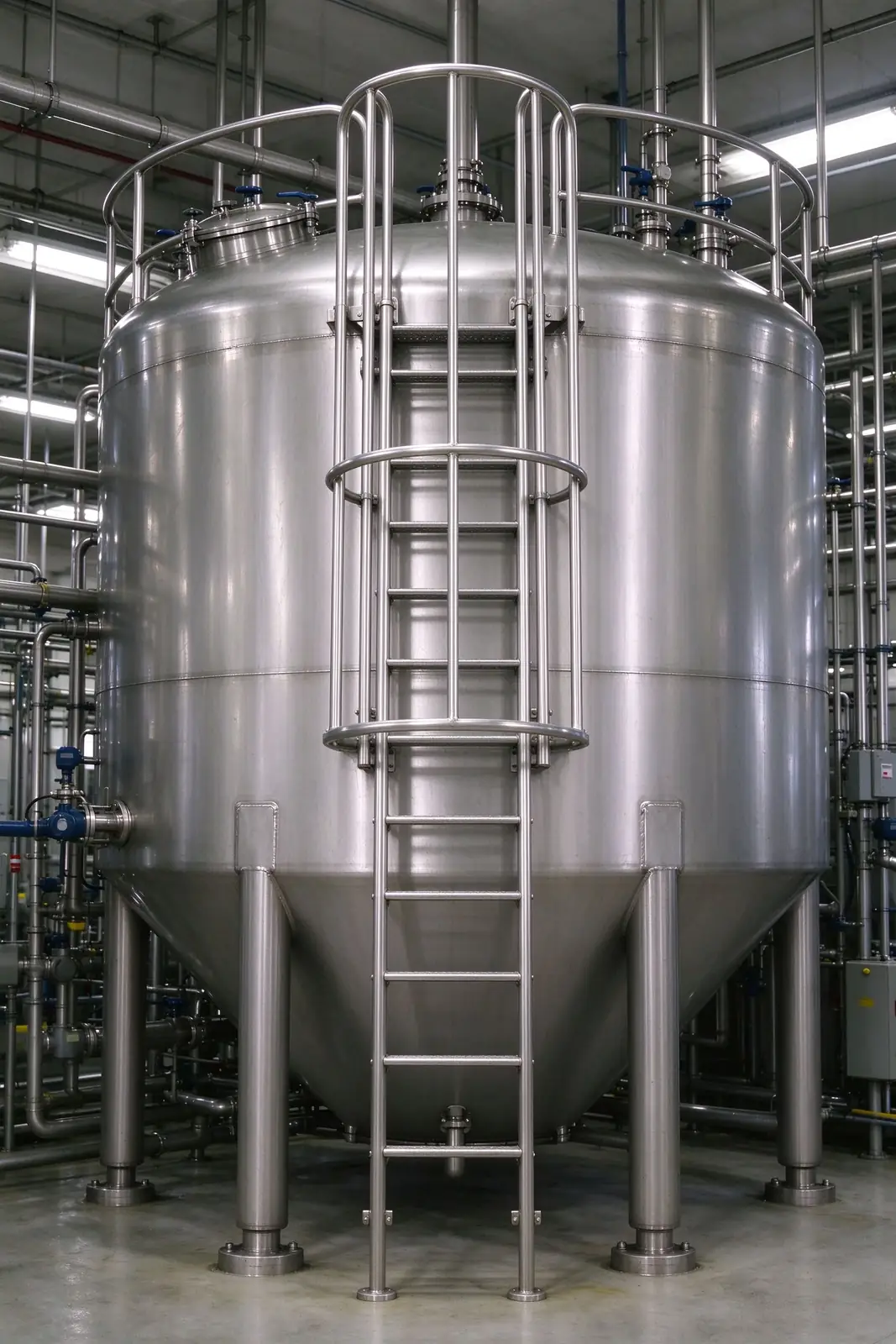
Caged Ladder
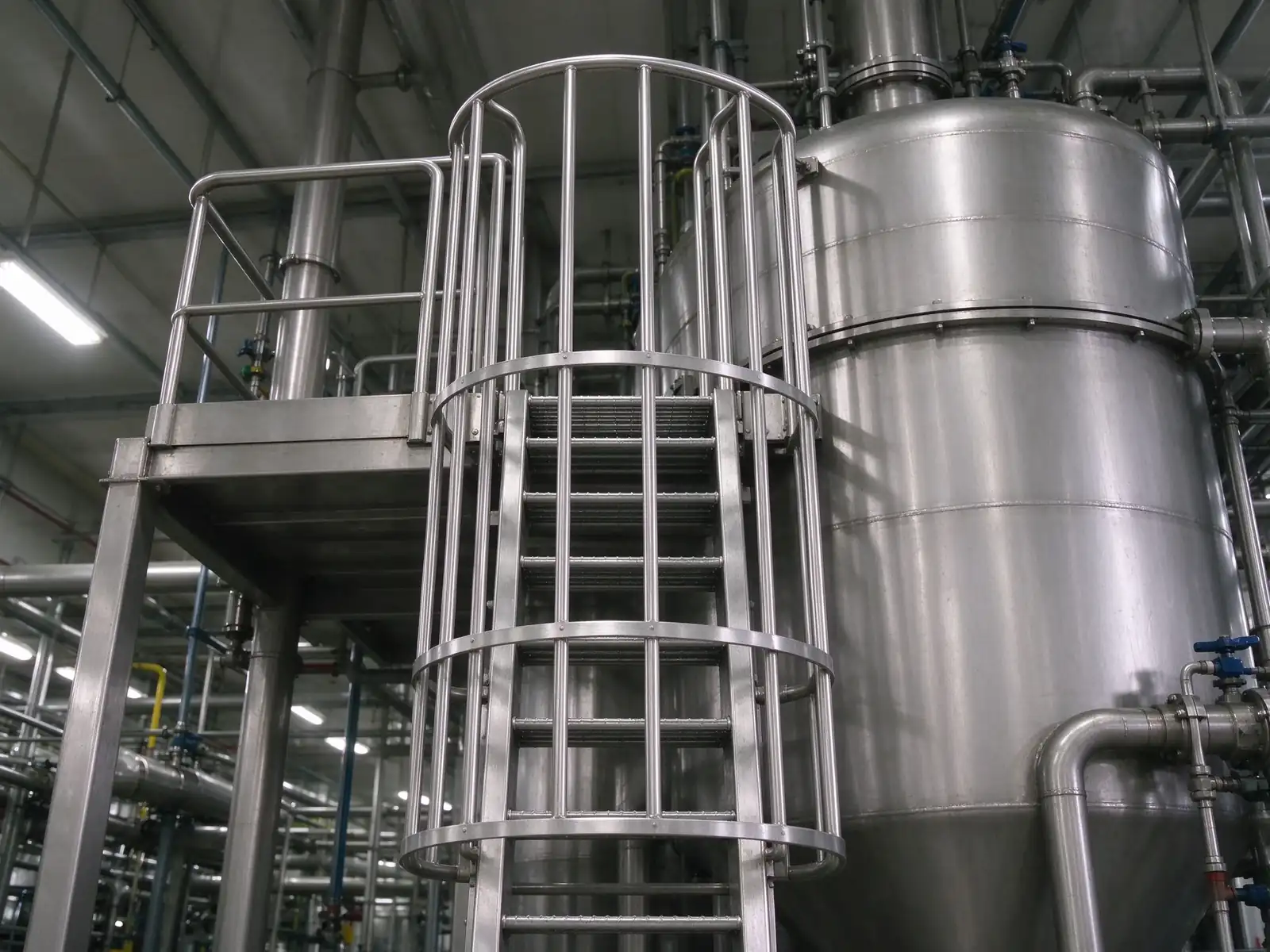
A vertical ladder wrapped by hoops and vertical guards around the climbing space, giving fall protection. This is the standard configuration for most roof and tank access.
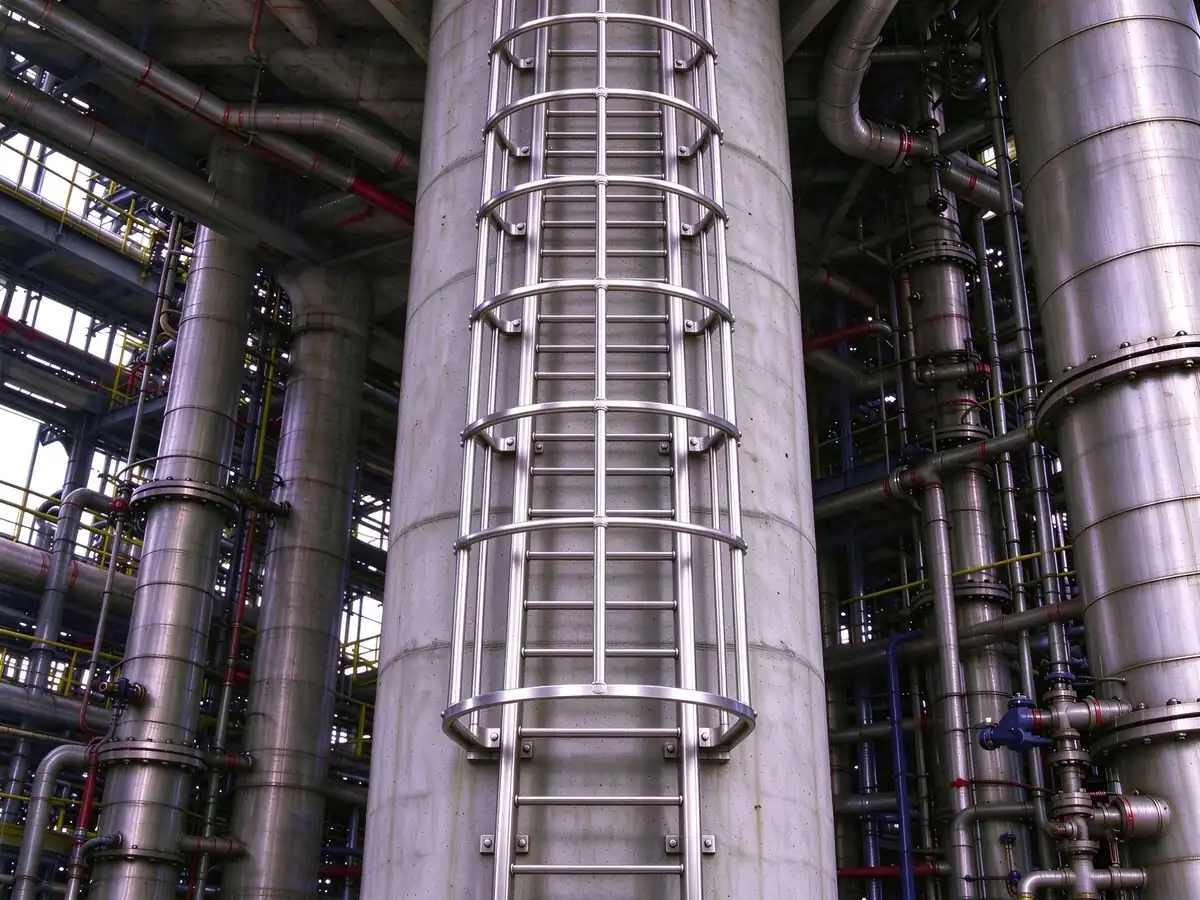
Caged Ladder with Top Handrail
Adds a top handrail that extends above the landing to guide the climber onto the platform. Required where side rails must extend 1.1m (42") above the access level.
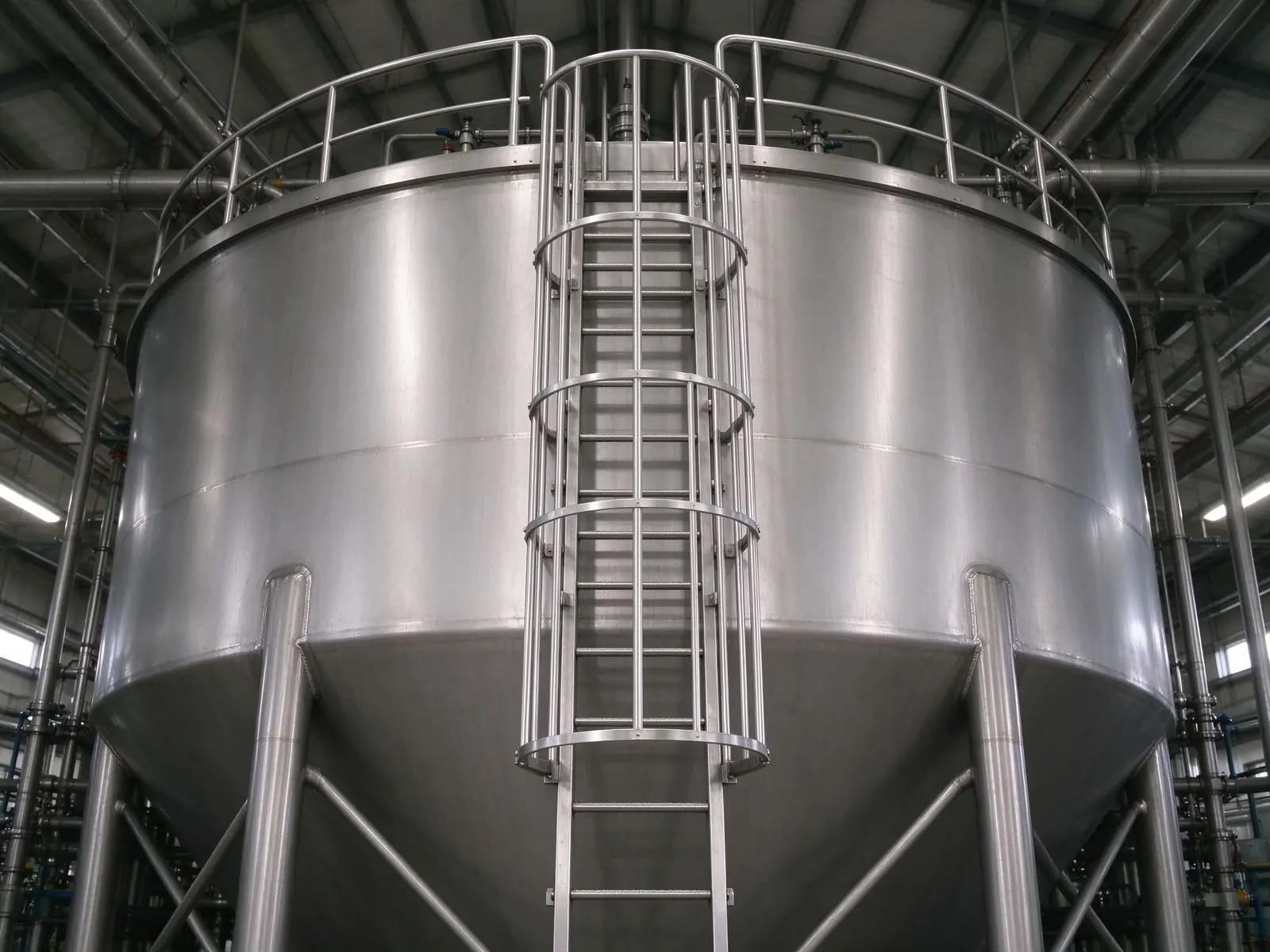
Fixed Ladder with Safety Cage, Intermediate Rest Platforms (Landings) and Guardrails
The full system with intermediate rest platforms for tall climbs, reducing fatigue on multi-storey access. Platforms split the climb every 6m and allow safe stepping off.
Why Stainless Steel? The Material That Never Fails
Stainless steel is the difference between a ladder that stays hygienic and corrosion-free and one that rusts in service. Here is what, why, how and when from a manufacturer’s perspective.
What is stainless steel?
Stainless steel is a chromium-alloyed steel. The chromium forms an invisible, self-healing oxide film that stops rust. SS304 covers general corrosion; SS316 adds molybdenum for chlorides and sea air. There is no coating — the protection is in the material itself.
Why stainless matters for hygiene & safety
Corrosion and coating flaking contaminate surfaces and threaten structural integrity. Stainless steel stays clean and strong for its whole life, so fall protection, load capacity and hygiene stay intact. It is the safety and sanitation guarantee beneath the cage.
How we finish it
TIG full-penetration welding → grinding and brushing → acid pickling & passivation to rebuild the passive film → optional mirror polish for hygienic zones. The result is a clean, corrosion-proof surface that needs no coating.
When stainless is the right choice
For food & beverage, pharmaceutical GMP, water treatment, coastal/marine, chemical and frequent-washing environments, stainless steel is the necessary upgrade — no coating to fail, no contamination risk. For dry inland general use, galvanized carbon steel is the economical alternative.
Material Properties & Service Life
| Base Steel | SS304 / SS316 austenitic stainless steel. SS304 (18Cr–8Ni) for general corrosive and hygienic duty; SS316 adds molybdenum for chlorides, sea air and chemical washdown. Excellent weldability, toughness and ductility. |
|---|---|
| Corrosion Protection | Inherent — a chromium passive film (≈10.5%+ Cr) forms spontaneously in air and self-heals when scratched. No coating to chip, flake or fail. Specify SS316 for chloride, coastal and chemical environments. |
| Surface Finish Options | • Brushed / mill finish — standard, hides handling marks • Pickled & passivated — removes weld heat tint, rebuilds a uniform passive film • Mirror polish (low Ra) — for food & pharma hygienic zones, per GMP / EHEDG |
| Load & Strength | High strength with excellent toughness. Designed per EN ISO 14122 / OSHA 1910.27 — 1.5 kN concentrated load on rungs, 3 kN on side rails, with full-penetration TIG welds. |
| Service Life | Decades — typically 30+ years inland and in humid / outdoor air, with no coating to fail. In coastal or chemical duty, SS316 gives the longest life; periodic washing keeps the surface clean and the passive film intact. |
| Best Applications | Food & beverage plants, pharmaceutical GMP areas, water treatment, coastal / marine, chemical and frequently washed hygienic environments. For dry inland general use, hot-dip galvanized or carbon steel is the economical alternative. |
| Maintenance | • Wash off salt, acid and organic deposits with mild detergent and water • Do not use carbon-steel tools or wire brushes on the surface (iron contamination) • Inspect welds and cage connections annually • Re-passivate heat-tinted or scratched areas if required |
| Touch-Up Procedure | 1. Clean the scratched / damaged area 2. Lightly grind or brush along the grain 3. Apply pickle paste or passivation gel to rebuild the passive film 4. Rinse thoroughly with clean water — the chromium film self-heals in air |
| Cost Efficiency | Higher upfront material and fabrication cost (TIG welding, pickling & passivation), but the lowest lifetime cost — no coating, no repainting, no rust repair. Best ROI for hygienic, coastal and long-life installations where downtime or contamination is costly. |
Where Our Stainless Steel Caged Ladders Are Installed
Stainless steel caged ladders are the standard vertical access for food, pharmaceutical, coastal, chemical and hygienic facilities worldwide.
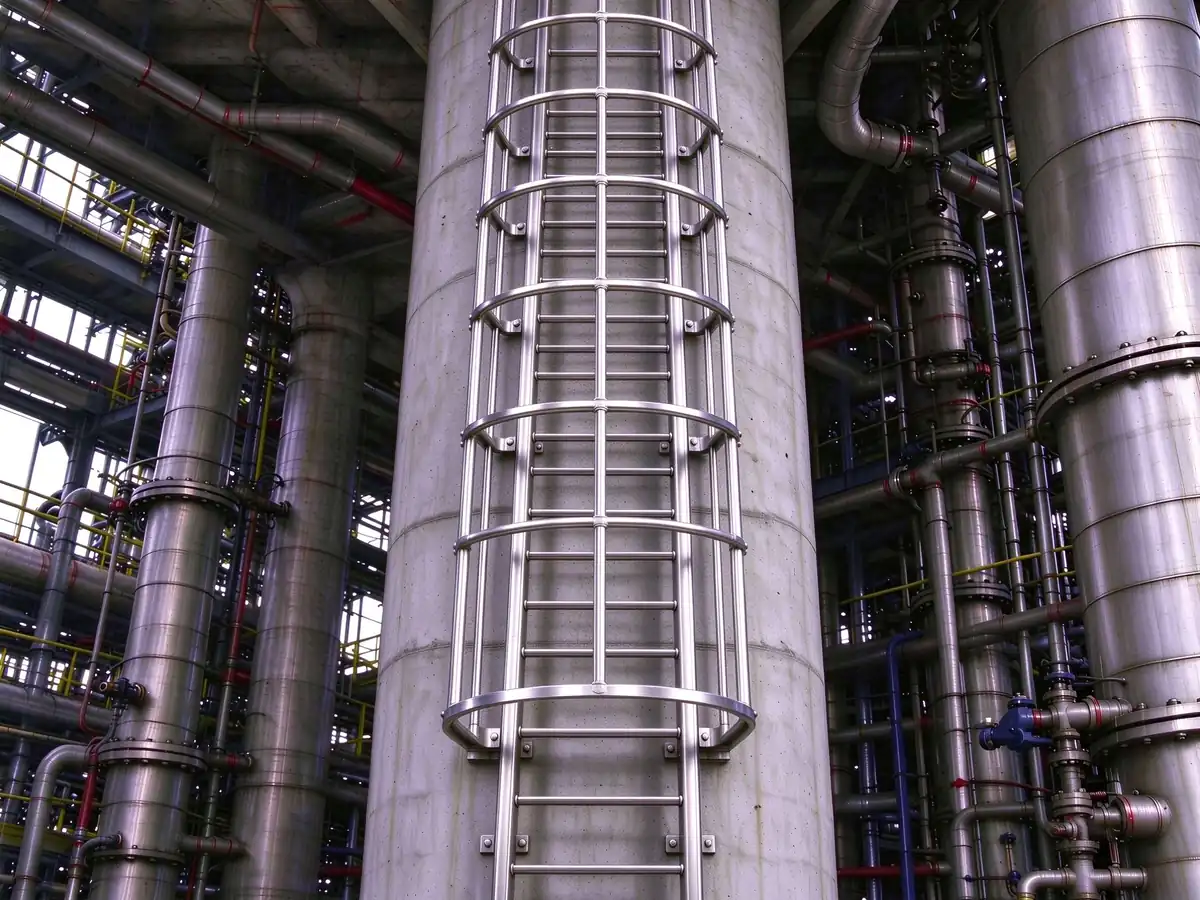
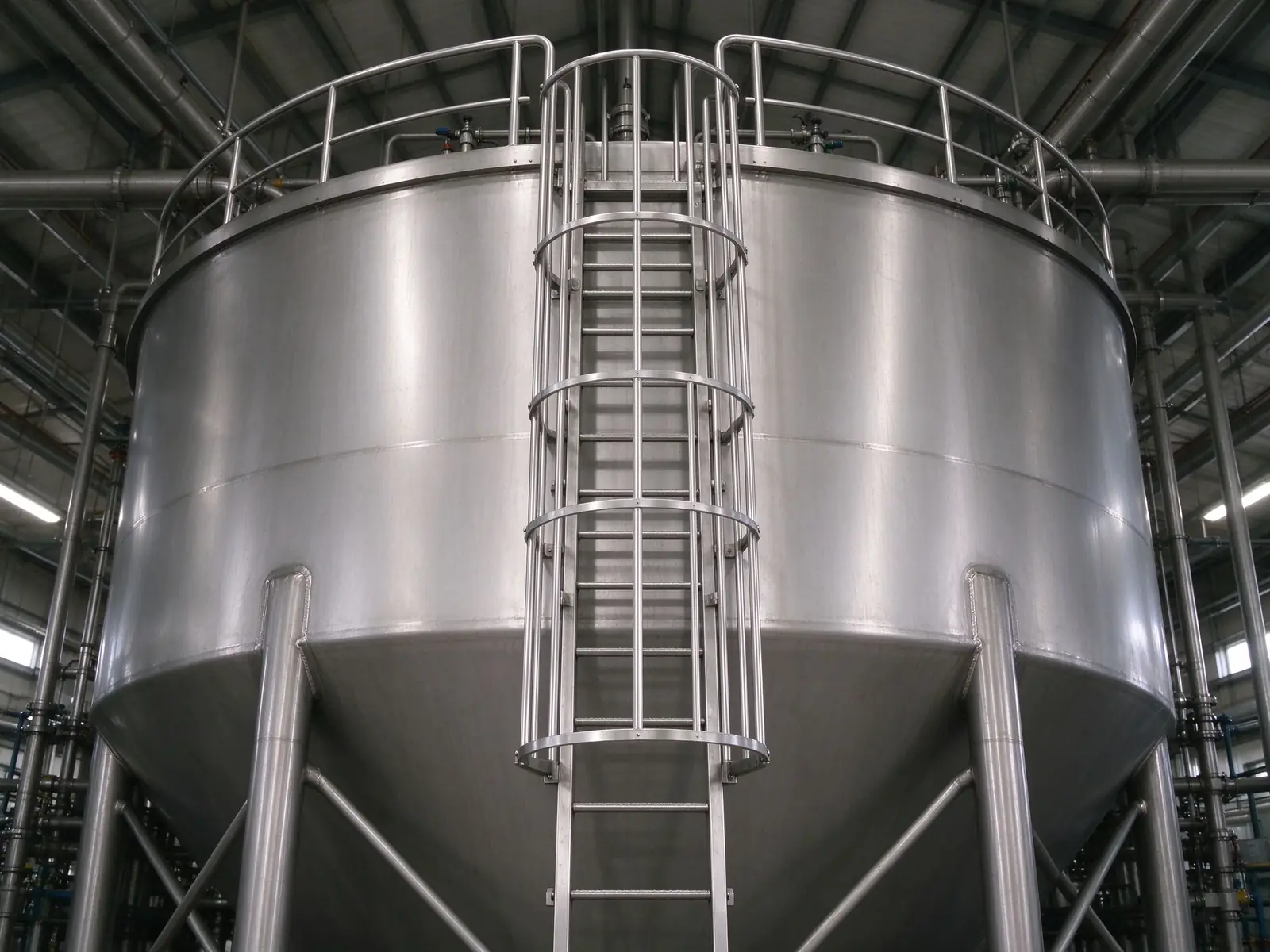
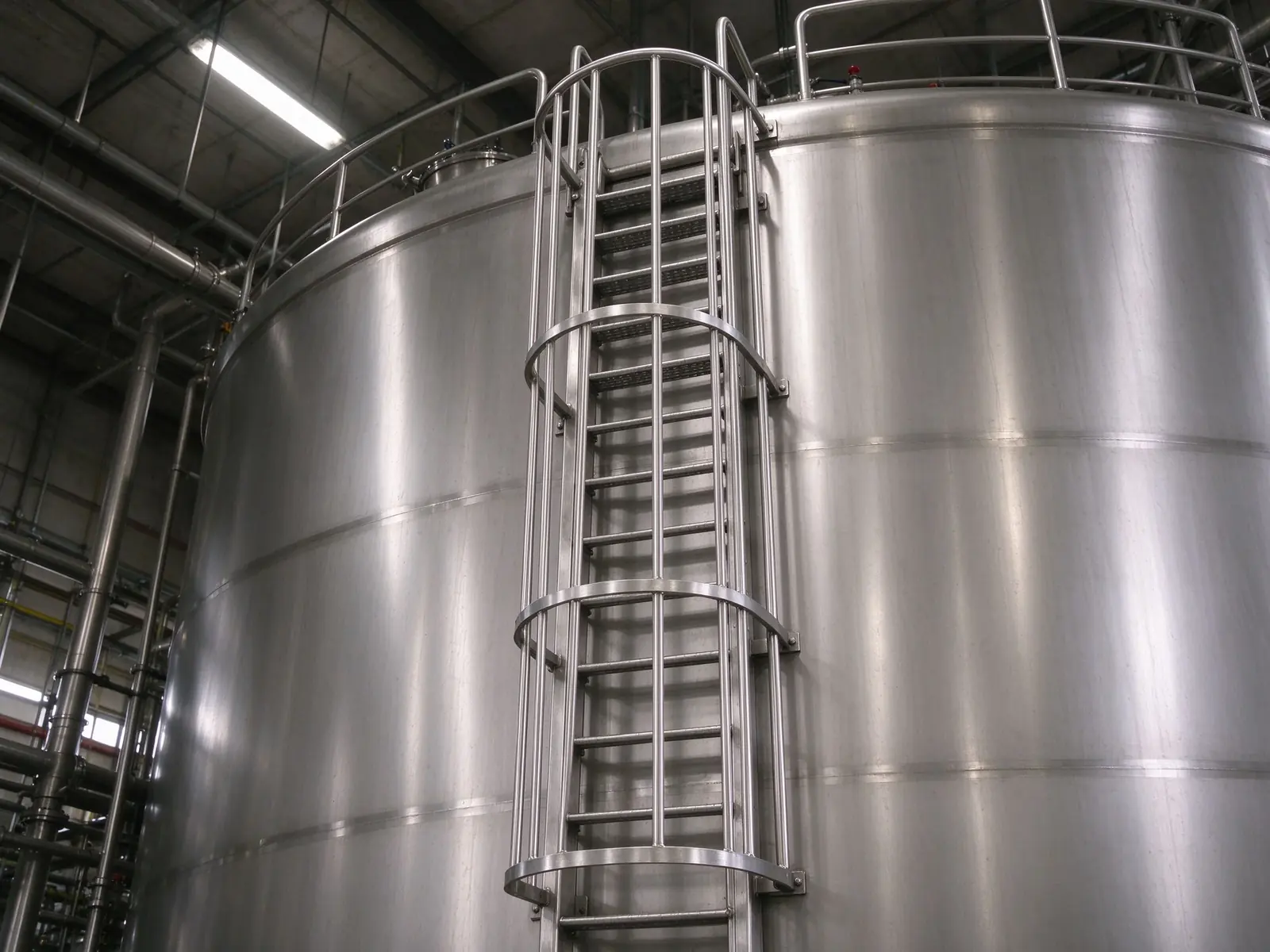
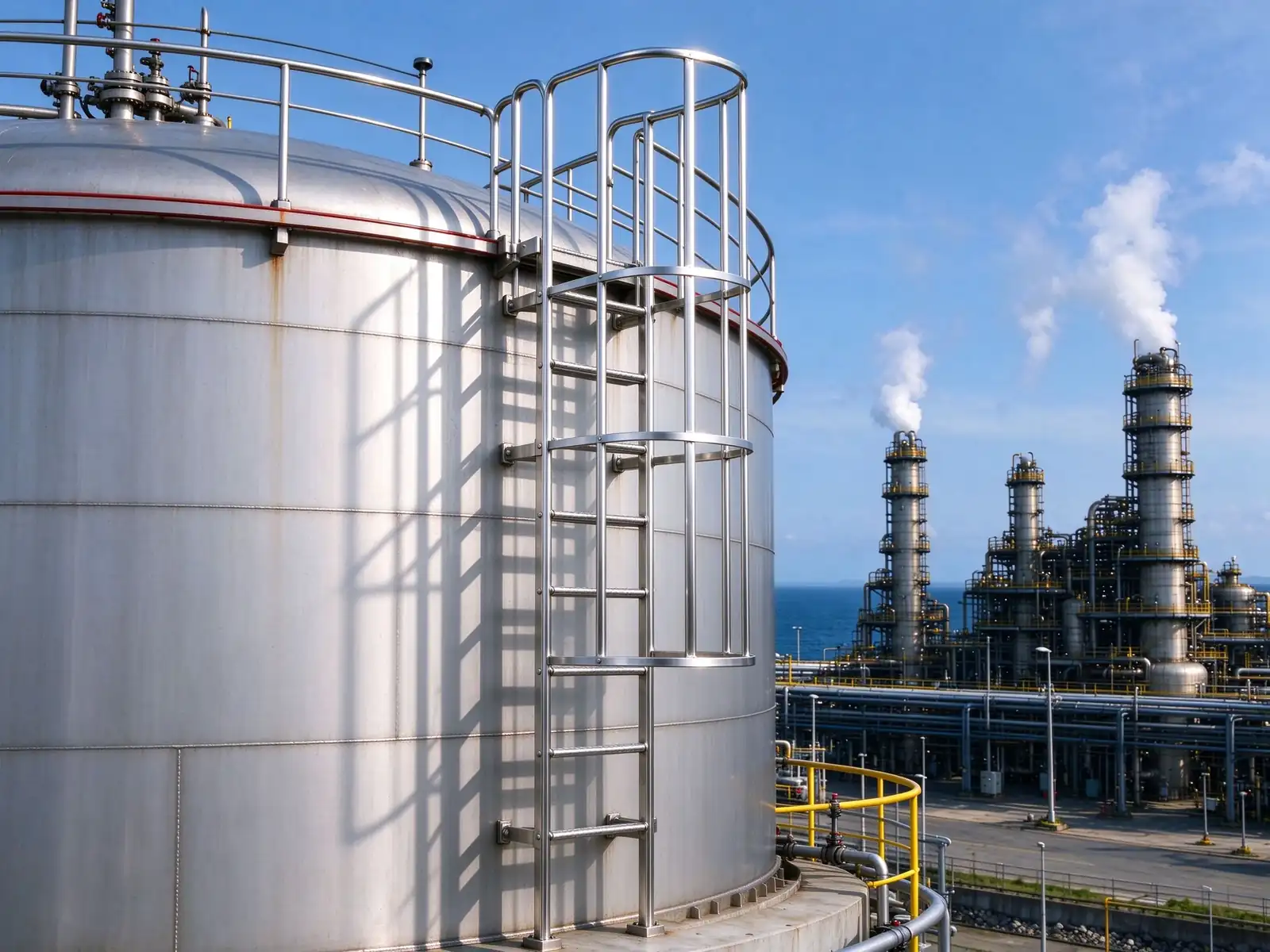
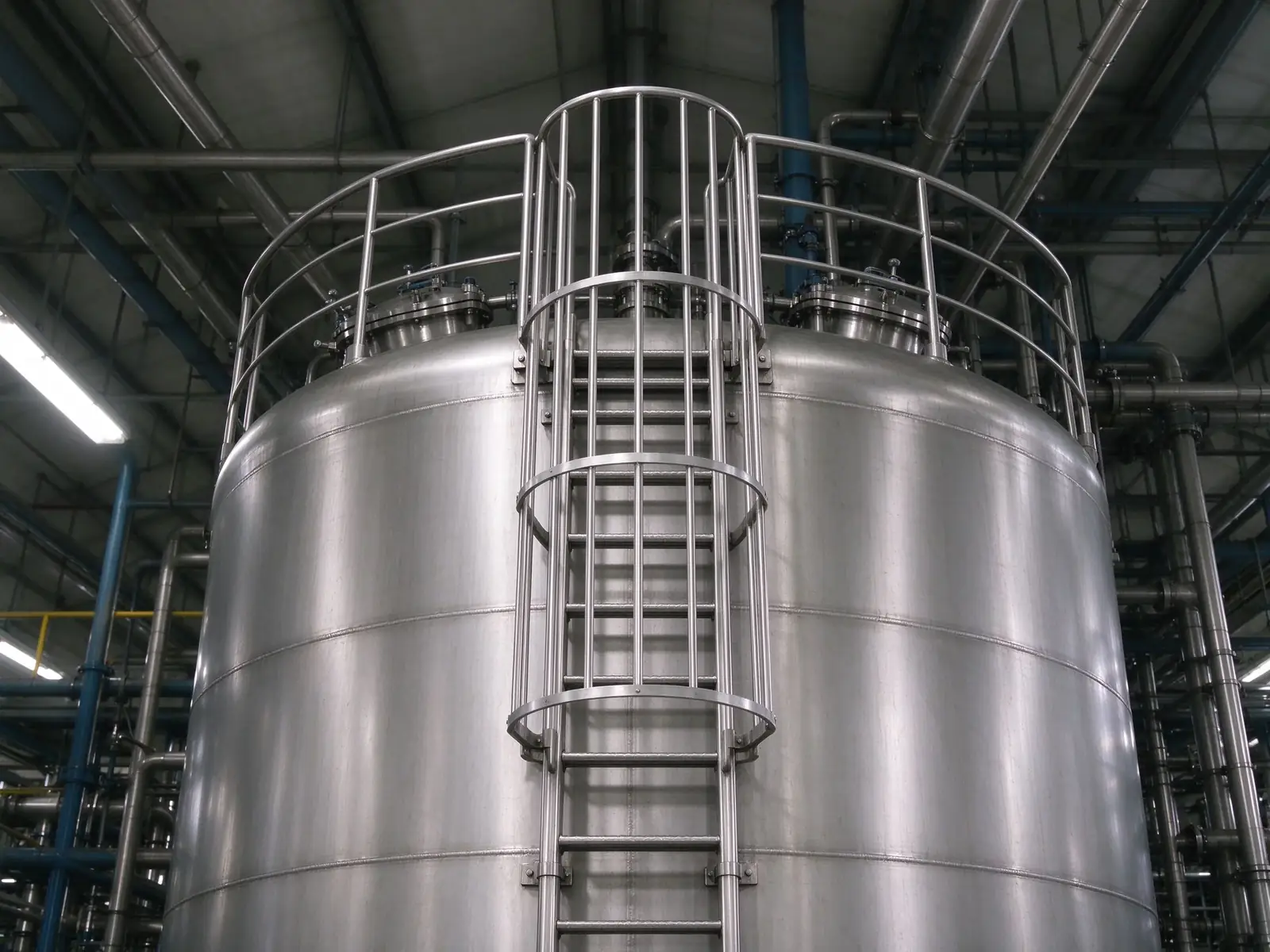
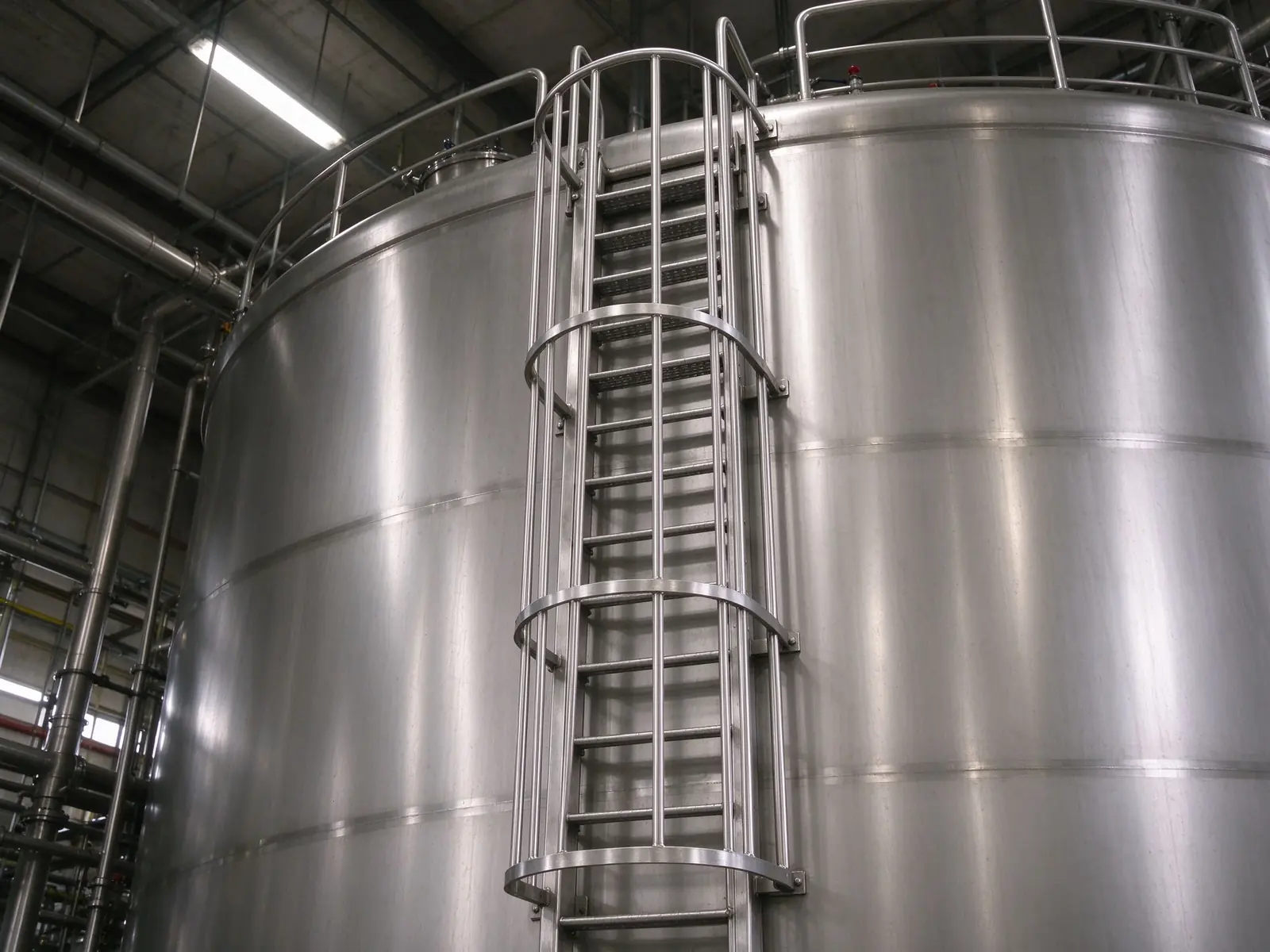
Storage Tanks & Silos
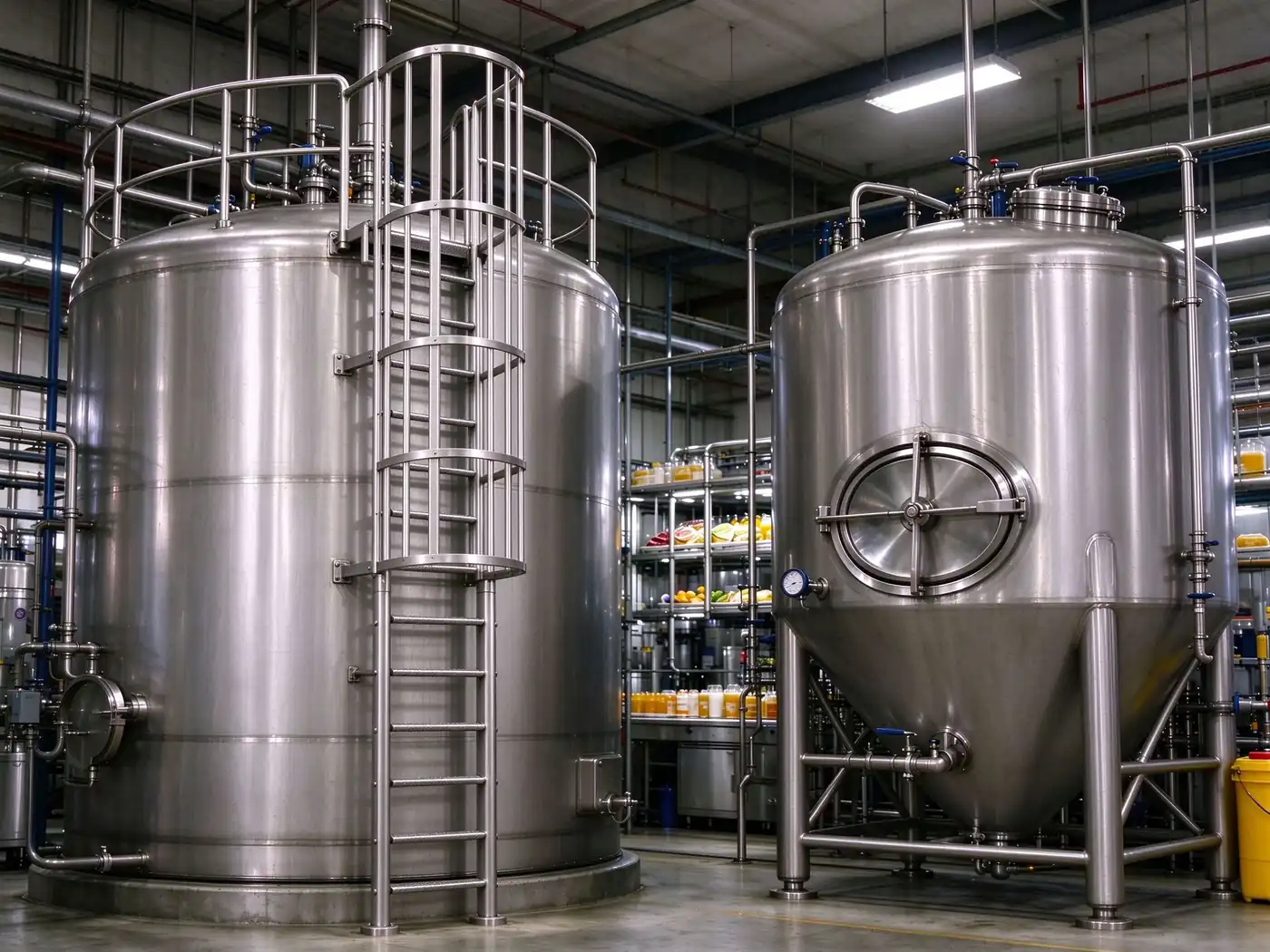
External caged ladders for tank-top valves, silo roofs and vessel inspection — the most common installation.
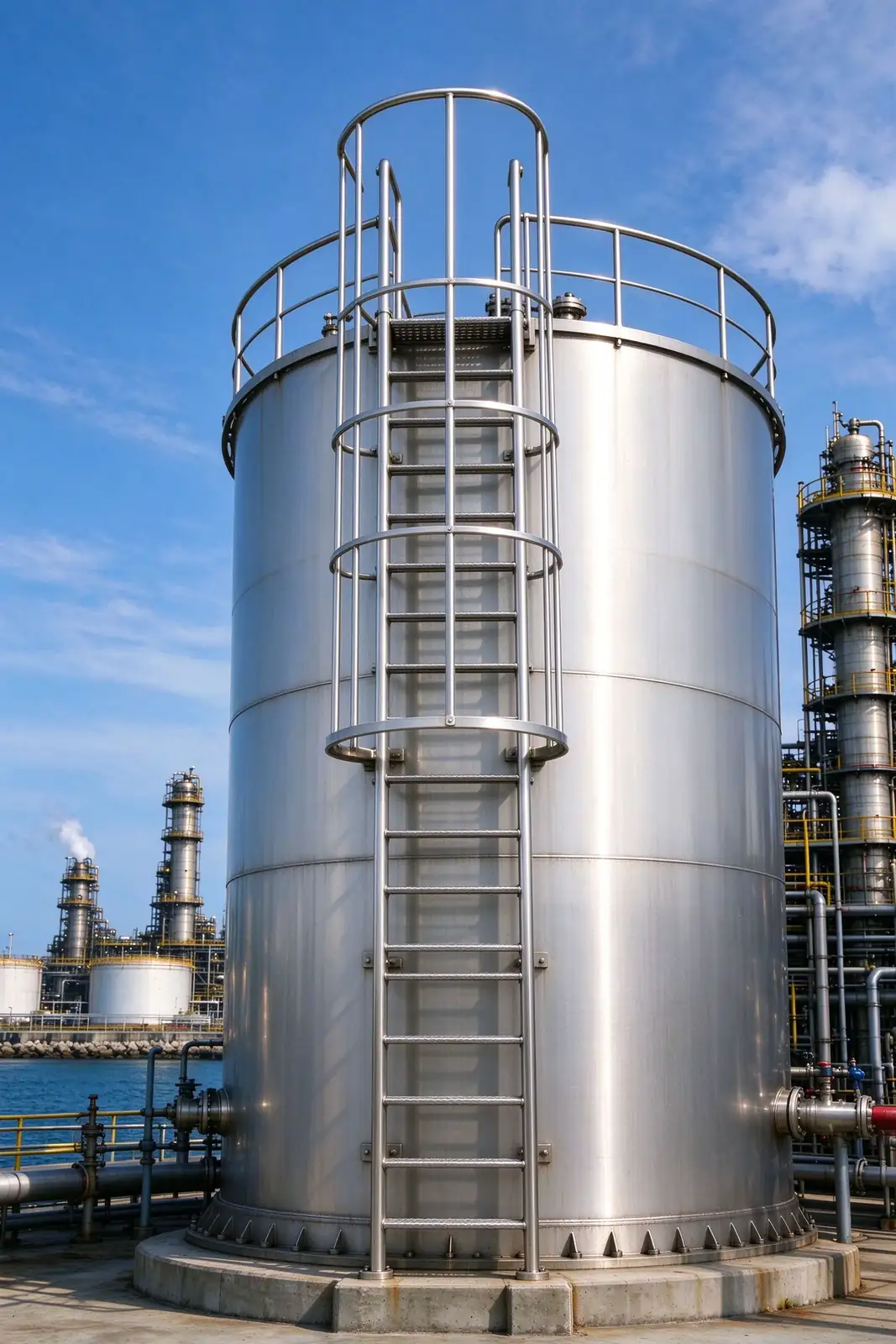
Plants & Process Platforms
Access to elevated equipment platforms, boilers, chimneys and process structures in industrial plants.
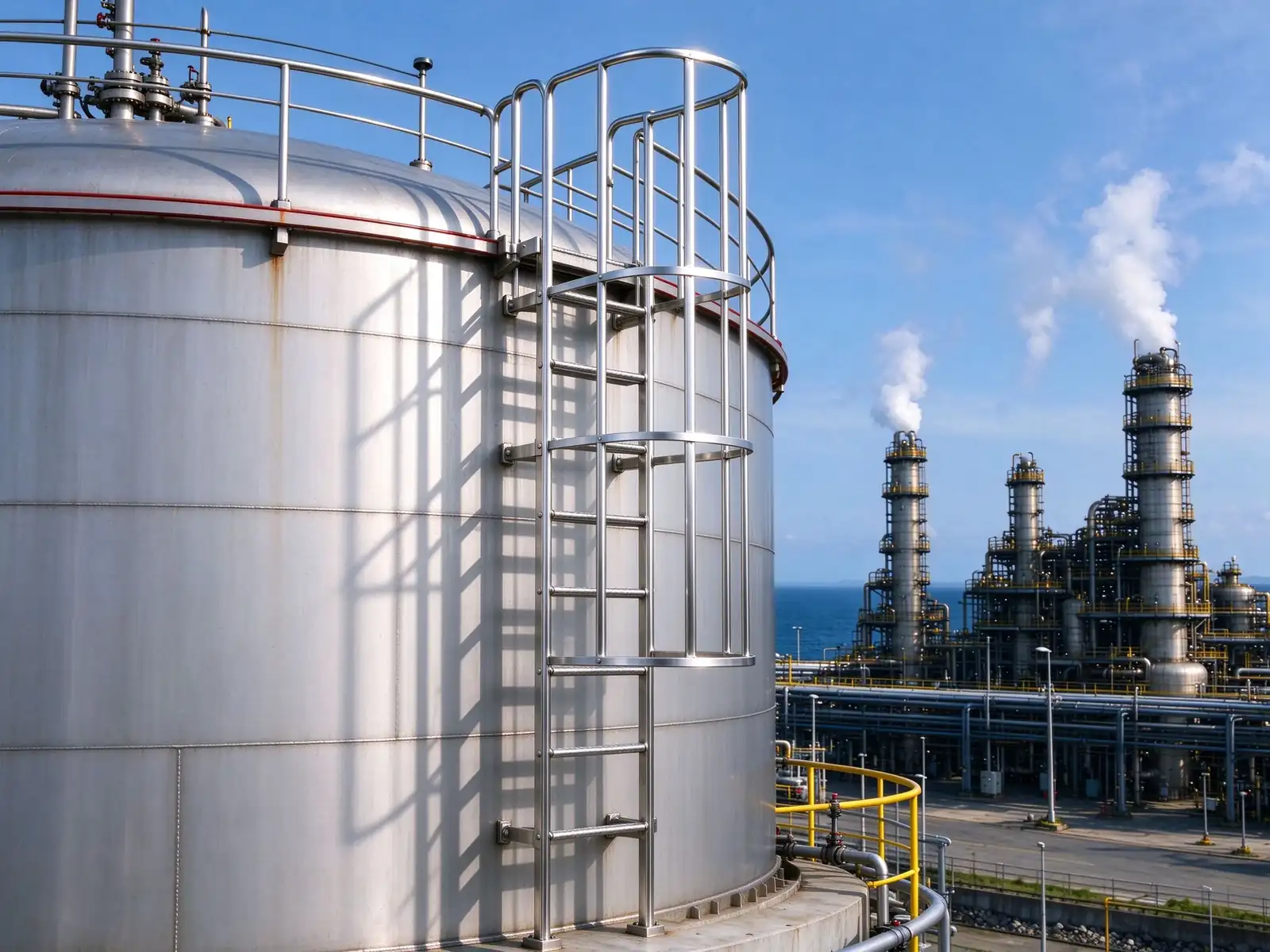
Roof Access & Water Towers
Wall-mounted or external caged ladders reaching roofs, penthouses and water towers with no stair room.
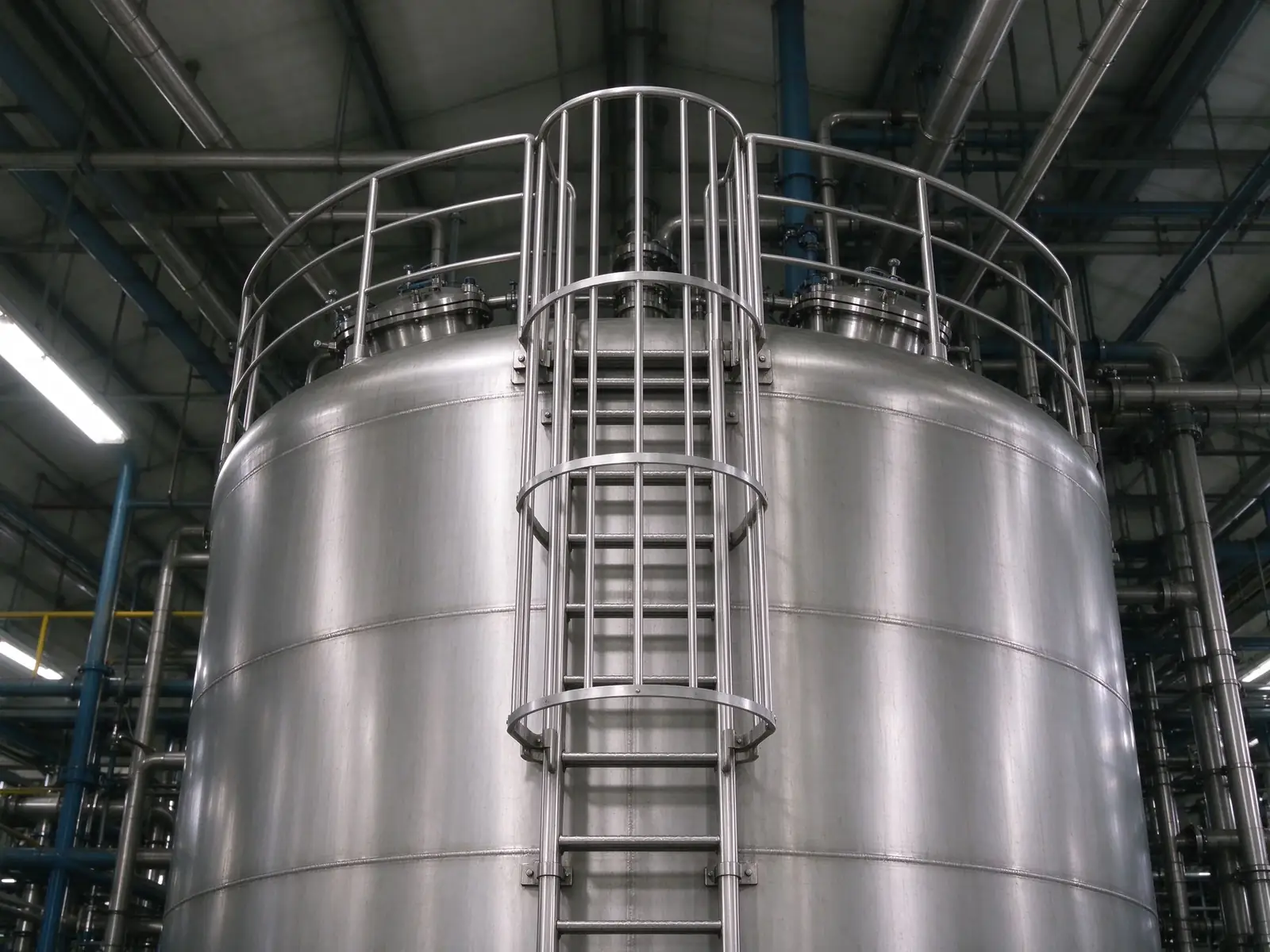
Building Exteriors & Walls
Vertical access on building facades and boundary walls for inspection and maintenance.
Steel Structures & Substations
Caged ladders on steel columns and frames for access to elevated levels during and after construction.
Factories & Warehouses
Maintenance and inspection access on building exteriors, mezzanines and equipment in factories and warehouses.
Stainless Steel Caged Ladder Case Studies
Six real installations by DengTAI — stainless steel caged ladders supplied and installed across food, pharmaceutical, coastal and municipal projects.
Exterior Wall Access — Plant
Stainless caged ladder installed on a plant exterior wall, reaching the roof edge for inspection access.
Corrugated Metal Building
Stainless caged ladder on a corrugated metal-clad wall, providing maintenance access to a rooftop structure.
Building Facade Access
Vertical stainless caged ladder mounted on a building facade, extending from ground to the roof platform.
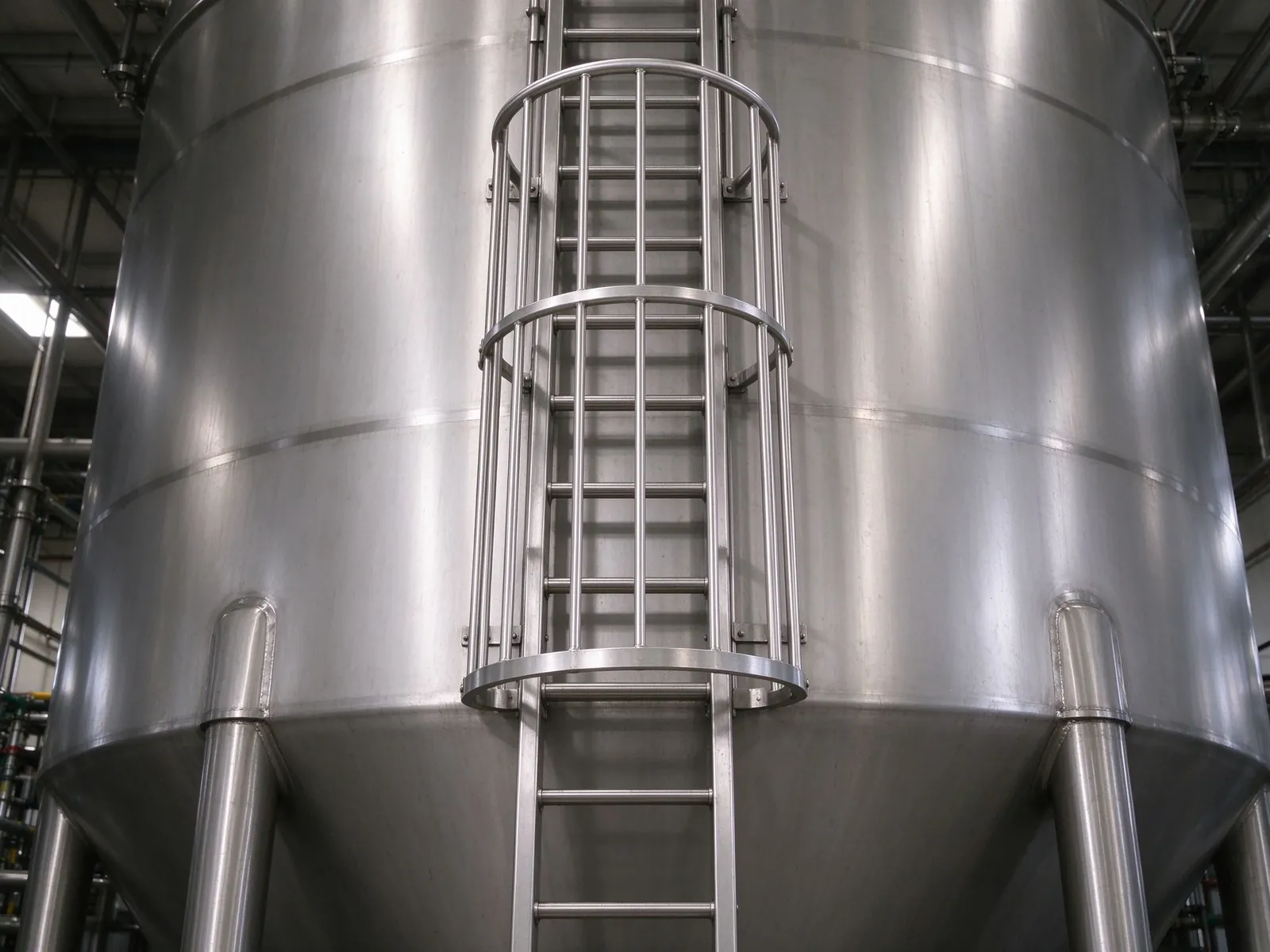
Wall-Mounted Equipment Access
Stainless caged ladder fixed beside windows and wall services, giving safe access to roof-level equipment.
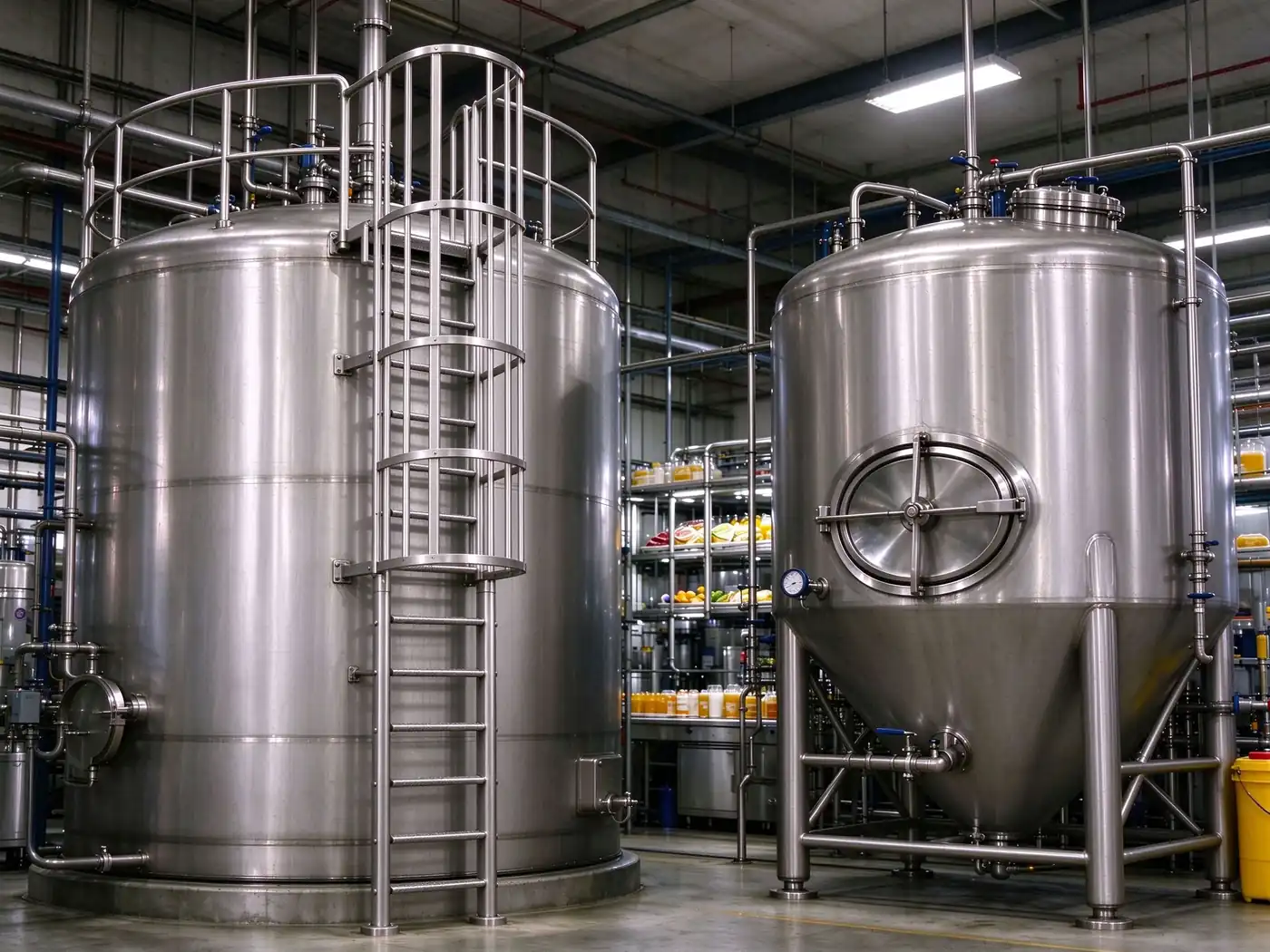
Modern Building Exterior
Clean stainless caged ladder on a modern building wall, combining safety with a tidy, corrosion-free finish.
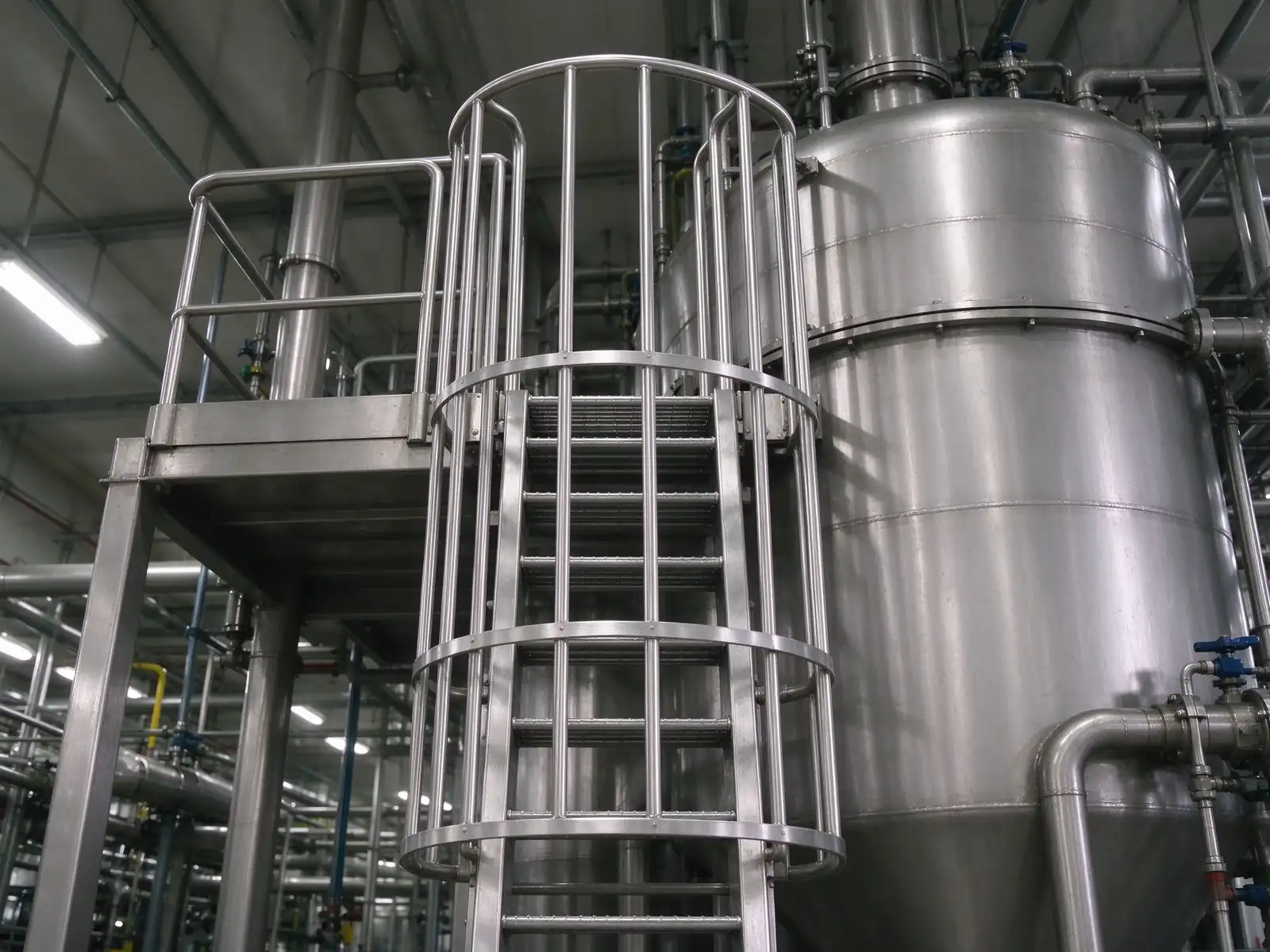
Rooftop Terrace Access
Stainless caged ladder reaching a rooftop terrace, integrated with the perimeter guardrail.
Made In Our Own 3,000m² Workshop
DengTAI Stair Manufacturing Co., Ltd. is a stair & ladder manufacturer from Shijiazhuang, Hebei, China — with in-house cutting, stainless welding, finishing and assembly under one roof.
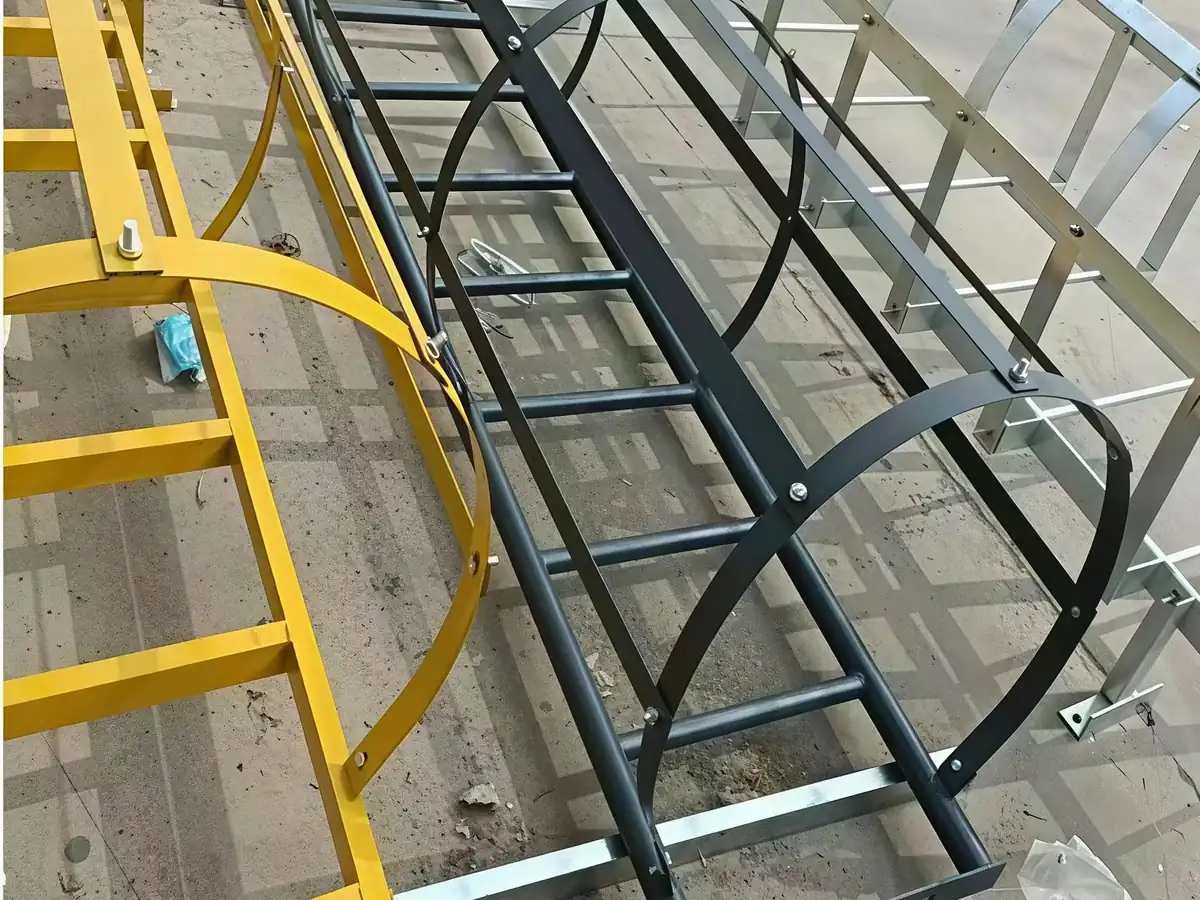
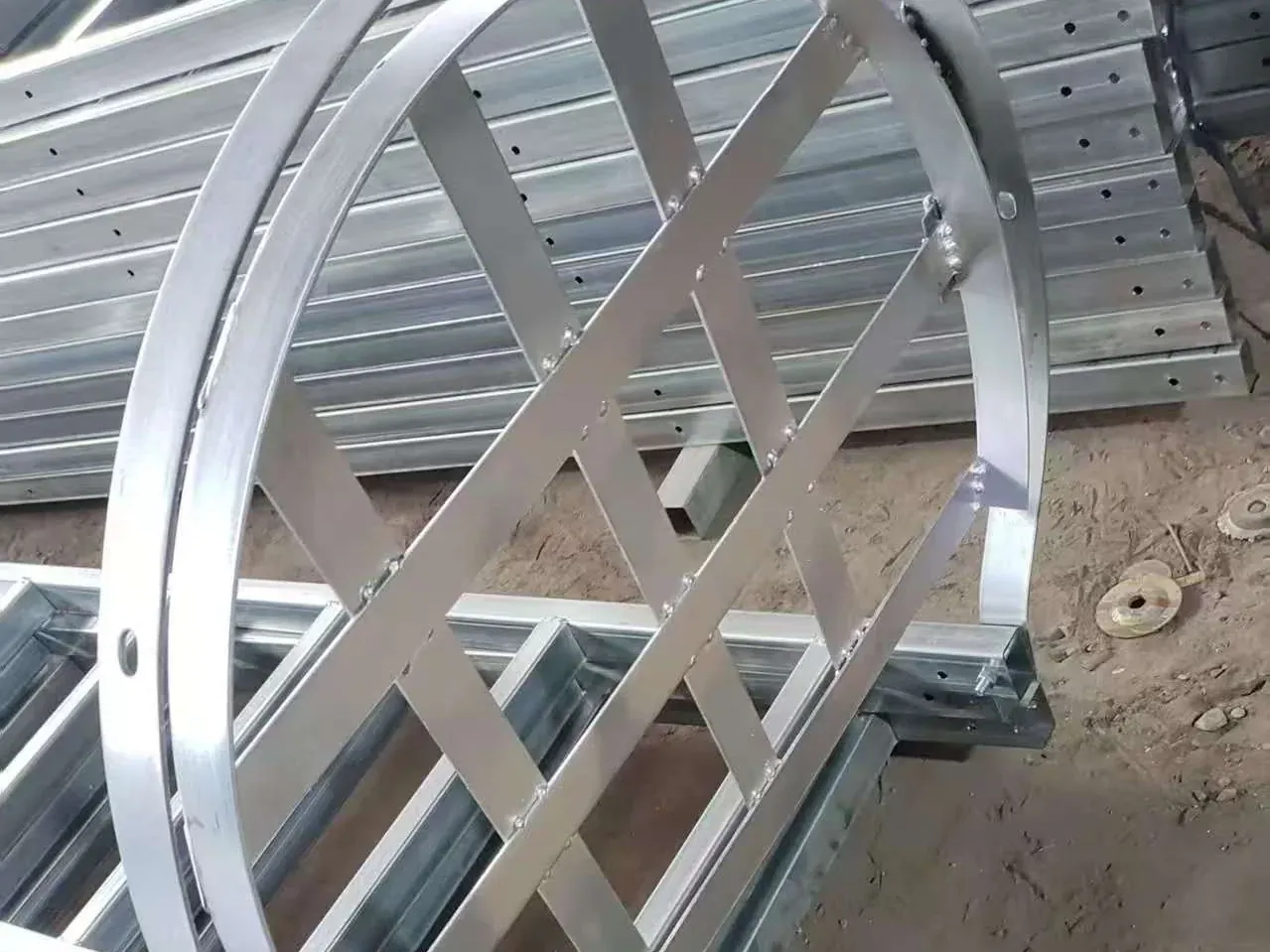
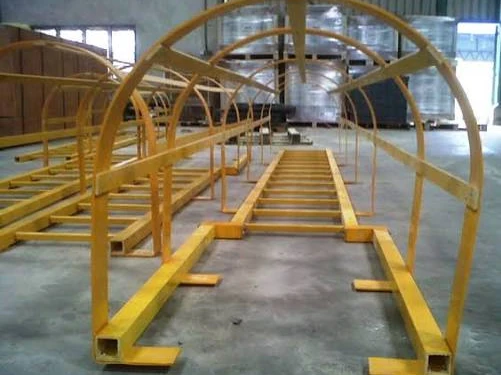
| Workshop Area | 3,000 m² standardized production workshop in Shijiazhuang, Hebei, China. Purpose-built for stair & ladder manufacturing with dedicated zones for cutting, welding, surface treatment, assembly, and quality control. |
|---|---|
| Workforce | 50+ skilled workers including: CNC operators, certified welders (CSWP / ISO 9606), assembly technicians, quality inspectors, and in-house design engineers. Average 8+ years industry experience. |
| Production Capacity | 3 dedicated production lines with daily output exceeding 240 meters of caged ladder (≈8–10 full systems per day). Annual capacity: 60,000+ linear meters of fixed ladders. |
| Certifications | • ISO 9001:2015 quality management system • CE marking for construction products • SGS / TÜV / BV third-party inspection available • Material mill certificates per EN 10204 3.1 |
| Engineering & Design | In-house engineering team designs per customer drawings and regional standards: GB 4053 (China), OSHA 1910.27 (US), EN ISO 14122 (EU), AS/NZS 1657 (Australia). All designs include structural calculations and fabrication drawings. |
| Product Range | • Fixed vertical ladders (plain / caged / with platforms) • Materials: carbon steel, hot-dip galvanized, stainless steel, aluminum, FRP • Custom heights: 2m to 30m+ • Accessories: rest platforms, safety gates, fall arrest systems |
| Export Experience | 10+ years export experience serving clients in 30+ countries across Europe, North America, Southeast Asia, Middle East, and Australia. Familiar with Incoterms, shipping documentation, and local code compliance. |
| Delivery & Installation | • Knock-down packaging for container shipping • Dedicated-vehicle domestic delivery • Professional installation team available (China & overseas) • Remote-guided installation via video call for DIY clients |
| Quality Control | • Incoming material inspection (steel grade, dimensions) • In-process weld inspection (visual + dimensional) • Coating thickness testing (powder coat / galvanizing) • Final load test on every rung + side rail • Pre-shipment inspection with photo/video report |
From Steel to Finished Ladder — Our Process
Every stainless steel caged ladder is made and tested in our workshop under one roof, from raw stainless stock to finished, passivated units.
- Cutting
SS304/316 stainless sections cut to drawing — flat bars, round bars and angles.
- Welding
TIG full-penetration welding of rails, rungs, hoops and guards in stainless, with weld inspection.
- Finishing
Grinding and brushing; pickling & passivation forms the chromium passive film; mirror polish optional for hygienic zones.
- Assembly
Rails, rungs, hoops and uprights assembled — bolted or welded connections.
- Inspection
Weld quality, surface finish, rung load tests and dimensional checks.
- Documentation
Mill certificates (heat traceable), weld reports, passivation records and load test data — SGS / TÜV / BV available.
Installation Guide
Correct anchoring is critical for a caged ladder’s safety. We provide detailed installation drawings and optional remote-guided on-site installation.
Key Installation Points
| Anchoring Type | • Wall-mounted — L70×6mm stainless angle brackets, welded or bolted to side rails • Tank / silo-mounted — curved stainless brackets to follow vessel radius • Roof-mounted — stainless support frame bolted to roof structure • Freestanding — base plate with anchor bolts, for ground-level installations |
|---|---|
| Bracket Spacing | Standard 1.5m vertical spacing (every other rung). Heavier-duty spacing for wind-loaded or tall installations. Brackets in matching stainless grade (304/316) to avoid galvanic corrosion. |
| Cage Start Height | Safety cage begins 2.1–2.4m (7–8ft) above ground / lower landing. This prevents unauthorized climbing while allowing safe access from the ground. The bottom 2.1m of side rails are visible and unprotected — standard per OSHA / EN. |
| Rest Platforms | Above 9m (30ft) total climb, add an intermediate rest platform every 6m (20ft). Platform width 1200mm, depth 800mm, with guardrails and toe boards. Platforms include a hatch or gate for safe passage through the cage. |
| Top Extension | Side rails extend 1.1m (42") above the upper landing / roof level as handrail. Provides a secure handhold when stepping onto the platform. Also includes a safety gate at the top opening to prevent falls. |
| Anchor Design | Custom engineered for your wall base material: concrete, steel, masonry, or specialty substrates. All anchor designs include pull-out load calculations, supplied in our detailed installation drawings with bolt sizes, embed depths and torque values. Stainless fixings (A2-70 / A4-70) to match grade. |
| Clearance Requirements | • Minimum 150mm clearance from wall to back of rung • Minimum 650mm clear width inside the cage • 700mm headroom above each rest platform • Keep 1m clearance around ladder base at ground level |
| Delivery & Installation | • Knock-down / modular packaging for easy transport through doorways • Dedicated-vehicle delivery to site (FTL or LTL) • Professional installation team available (China & overseas) • Optional remote-guided installation via video call |
| Testing & Certification | • Factory load test on every unit (rung + side rail) • Mill certificates (heat-number traceable) supplied • Welding inspection reports (TIG full penetration) • CE / OSHA / EN compliance documentation included |
Maintenance Guide for Long Service Life
Stainless steel caged ladders are low-maintenance, but a simple routine keeps them safe and extends their life.
Routine Inspection
Check rung welds, cage connections and surface condition regularly.
Clean & Passivate
Wash off deposits and re-passivate scratches so the passive film stays intact.
Load Limits
Do not overload — single-rung load 1.3–1.5kN; keep within rated capacity.
Regulatory Note
OSHA 1910.28: new ladders >24ft require a fall-arrest system (by 2036 all existing ladders). Confirm per your region.
Engineered to Your Regional Ladder Standard
Every stainless steel caged ladder is designed to the official fixed-ladder standard of your destination market, so cage geometry, dimensions and fall protection are built in — not guessed.
Cages for existing fixed ladders over 6.1m (20ft); new ladders over 7.3m (24ft) require a ladder safety system (LSS) or personal fall arrest. LSS mandatory on new ladders; cages phased out for new installs.
Cage mandatory for fixed ladders over 3m; single section ≤6m with rest platforms above; rung load 1.5kN. Cage diameter 650–800mm, hoops ≤1500mm.
Hooped / birdcage ladders; cage from 3m, incorporated with EN ISO 14122-4; stainless to BS EN 10088 for the wetted profile.
Fixed ladders with hoops; cage recommended above 6m; mid-way rest platforms mandatory on long climbs; rung load rated by assessment.
Steel ladders & safety cage per 15J401 atlas; roof access ladders caged from 7m; WT2 up to 10m, WT3 above 10m with platforms (6m spacing).
No coating, no contamination risk — brushed or mirror surface meets food and pharma hygiene requirements where specified.
Stainless Steel Caged Ladder FAQ
Answers to the questions buyers ask most.
When does a ladder need a safety cage?
Guidance varies by standard: EN ISO 14122-4 requires a cage for climbs over 3m, OSHA applies cage / fall-protection rules over 6.1m (24ft), and GB 4053.1 requires a cage from 7m on roof ladders. We engineer the correct cage per your destination country.
Which stainless grade — 304 or 316?
SS304 suits general corrosion and food/brewery use. SS316 adds molybdenum and is specified for coastal, chloride and chemical environments. We select the grade to your site and standard.
What is the strongest type of ladder?
For fixed vertical access, stainless steel caged ladders combine high strength with the best corrosion resistance — ideal for hygienic, coastal and chemical sites.
Does OSHA allow cages on ladders?
Yes — for existing fixed ladders over 24ft, cages are an accepted protection. New ladders over 24ft (per OSHA 1910.28) require a ladder safety system or personal fall arrest instead. We confirm per the code that applies to your project.
How long does a stainless caged ladder last?
With correct grade selection and simple cleaning, a stainless steel ladder typically serves decades without coating failure — the passive film self-heals and there is nothing to repaint.
Can I get a custom-height caged ladder?
Yes. Send your DWG, PDF or sketch — we design height, cage diameter, rung spacing, mounting type and platforms, and fabricate to your specification.
How to Get a Quote — What We Provide
Send us your details and we respond within 24 hours with engineering advice and a detailed quotation.
Please Provide
Height & Type
Working height and which type (plain / caged / +handrail / +platform).
Drawing or Sketch
DWG, PDF, CAD or a photo/sketch of the site and base material.
Destination Standard
Your country — we engineer to OSHA, EN ISO, BS, AS or GB.
Quantity & Delivery
Number of ladders, target port or delivery address.
Your Quotation Includes
| Itemized Price | Per model, per meter or per set |
|---|---|
| Dimensions | Height, cage diameter, rung spacing, platform sizes |
| Weight | Net weight per ladder (kg) |
| Surface Area | Stainless surface area for finishing reference |
| Materials | Specified rails, rungs, hoops, brackets and fixings |
| Standards | Applied standard and compliance notes |
| Delivery | FOB / EXW / CIF options, lead time and shipping |
| Certificates | Mill, weld, passivation and load-test documents (SGS / TÜV / BV optional) |
Request a Quote
Fill in the details below and we will reply within 24 hours with engineering advice and a detailed quotation.
Stainless Steel Caged Ladder — Common Questions
SS304 vs SS316 — which do I need?
SS304 works for most food, pharma and indoor applications. SS316 has molybdenum added for better chloride resistance — choose SS316 for coastal areas, chemical plants, wastewater treatment and swimming pools.
Does stainless steel need painting?
No. Stainless steel is inherently corrosion-resistant — no paint, no powder coating, no galvanizing. It stays clean and hygienic, perfect for food and pharmaceutical environments.
Is stainless steel worth the extra cost?
For coastal, chemical or hygienic environments, yes. The initial cost is higher, but you save decades of painting, rust repair and replacement. Total cost of ownership is often lower.
Get a Stainless Steel Caged Ladder Quote
Send your drawing or dimensions — we respond within 24 hours with engineering advice and a factory price.
Request a QuoteTel: +86 152 2651 7938 · Email: 289810621@qq.com · Mon–Sat 08:30–18:00 (GMT+8)